

Launch of the African Sovereign Debt Justice Network (AfSDJN) Paper Series
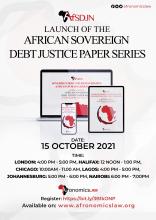
The African Sovereign Debt Network cordially invites you to join the launch of the AfSDJN paper series on October 15.
Kenya's Non-Appearance and Withdrawal: The Melodrama Before the ICJ
I am then wearing my ‘amateur’ hat to metaphorically ask: Is Kenya’s strategy terrible? To critically answer this question, I first consider the effect of the non-appearance of Kenya in the hearing on the merits of the case. Second, I look into the withdrawal of the declaration accepting compulsory jurisdiction the ICJ and what that means for the present case as well as for future disputes. Third, I provide concluding remarks.
Transitional Justice and Foreign Criminal Prosecutions: Delocalizing Justice?
While multinational companies at times play a notable role in conflicts and mass atrocity events, there is an ongoing debate on how and where to acknowledge their involvement when countries seek to come to terms with past wars or human rights violations. Should economic crimes and other types of corporate complicity be addressed within the Transitional Justice (‘TJ’) process? And considering that corporate involvement in conflicts is often transnational, what States and (domestic or international) judicial bodies should be involved in providing justice?
NEWS: 10.07.2021
The News and Events published every week include conferences, major developments in the field of International Economic Law in Africa at the national, sub-regional and regional levels as well as relevant case law.
The Coordination of the Foreign Policies of the Member States of CARICOM: A Contemporary Reappraisal
October 7, 2021
The Diplomatic Academy of the Caribbean of the University of the West Indies presents an online Webinar themed "The Coordination of the Foreign Policies of the Member States of CARICOM: A Contemporary Reappraisal".
It is tailored for those interested in acquiring substantive knowledge and real-world insight on the coordination of the foreign policies of the Member States of the Caribbean Community (CARICOM)
Corporate Personality under International Law and Justice Gaps: Could Delocalisation Prompt a Potential Role Within African Regional Courts Frameworks?
There is the potential to create regional or sub-regional frameworks, which through agreements can handle claims against companies within their territories. This may strengthen local regional capacity, alleviate the allegations of complicity of the state and exemplify the cooperative spirit embodied in more recent collaborative African action. It would demonstrate an attempt at African solutions which are not dependent on home states. Nevertheless, it may not be enough to counter the lack of legally binding responsibility grounded in international law, as it would not be able to bring parent companies, who reside outside the African jurisdiction, within its scope.
Call for Blogs: The Jindal Forum for International and Economic Laws
October 6, 2021
About us
La Participation Pour les Communautés Locales Africaines Dans la ‘Justice Délocalisée’ : Une Chimère?
L'accès à la justice et à un recours effectif est un principe important reconnu par les systèmes juridiques nationaux, régionaux et internationaux. En Afrique du Sud, par exemple, ce principe est consacré par l’article 34 de la Constitution qui affirme le droit de toute personne à ce que sa cause soit entendue publiquement et équitablement devant une cour ou tout autre tribunal ou forum indépendant et impartial. Au plan régional, les différents instruments de protection des droits de l’homme contiennent tous, une disposition relative au droit d’accès à la justice. Dans ce sens, l’article 7 de la charte africaine des droits de l’homme et des peuples affirme le droit pour chaque personne à ce que sa cause soit entendue (Voir aussi l’article 6 CEDH et l’article 8 CADH). Ce principe a aussi été repris par certains textes internationaux récents tels que les Principes directeurs relatifs aux entreprises et aux droits de l’homme (p. 31) ou encore les Objectifs de développent durable (objectif n°16)
Le PCN Français : Un Dispositif de Contrôle des Territoires d’Afrique Noire Francophone
Notre propos entend déconstruire le narratif sur la responsabilité des entreprises multinationales porté par les vainqueurs de l’ordre international économique établi depuis la fin de la Seconde Guerre mondiale. Nous entendons ainsi mettre en lumière les rapports dominants/dominés, pour ne pas dire les nouveaux rapports coloniaux, déterminant la distribution de la justice dans cet ordre. Il va s’agir plus précisément d’identifier les logiques sous-tendant la justice pour les victimes des multinationales françaises dans les États d’Afrique noire francophone à l’aune du Point de contact national de la France pour les Principes directeurs de l’OCDE à l’intention des entreprises multinationales (ci-après PCN)