
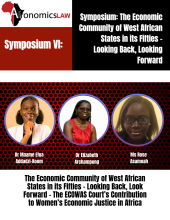
Symposium VI: The Economic Community of West African States in its Fifties – Looking Back, Look Forward - The ECOWAS Court’s Contribution to Women’s Economic Justice in Africa
Promoting economic cooperation and development among Member States has been the primary aim of the Economic Community of West African States (ECOWAS) since its inception in 1975. Unsurprisingly, in the beginning, the Community’s only judicial body, the ECOWAS Court, only had a mandate to foster socio-economic integration. Consequently, when the Court was granted a human rights mandate in 2005, it was expected that advancing economic justice and safeguarding economic rights would underpin its adjudicatory functions. The economies of countries in West Africa exhibit a significant gender gap, which manifests in various ways, including the gender pay gap, women disproportionately engaged in informal and vulnerable employment, unequal access to job opportunities, occupational segregation, unequal asset ownership, limited access to financial services, and unpaid care work.In this blog post, we provide a brief overview of two cases decided by the ECOWAS Court that concern women’s rights to work, showcasing the Court’s role in promoting women’s economic justice in the West African sub-region and beyond. However, before discussing these cases, which inform our conclusions, we briefly explore the nature of the right to work for women within the African human rights system.