Social Justice

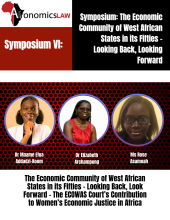
Symposium VI: The Economic Community of West African States in its Fifties – Looking Back, Look Forward - The ECOWAS Court’s Contribution to Women’s Economic Justice in Africa

Promoting economic cooperation and development among Member States has been the primary aim of the Economic Community of West African States (ECOWAS) since its inception in 1975. Unsurprisingly, in the beginning, the Community’s only judicial body, the ECOWAS Court, only had a mandate to foster socio-economic integration. Consequently, when the Court was granted a human rights mandate in 2005, it was expected that advancing economic justice and safeguarding economic rights would underpin its adjudicatory functions. The economies of countries in West Africa exhibit a significant gender gap, which manifests in various ways, including the gender pay gap, women disproportionately engaged in informal and vulnerable employment, unequal access to job opportunities, occupational segregation, unequal asset ownership, limited access to financial services, and unpaid care work.In this blog post, we provide a brief overview of two cases decided by the ECOWAS Court that concern women’s rights to work, showcasing the Court’s role in promoting women’s economic justice in the West African sub-region and beyond. However, before discussing these cases, which inform our conclusions, we briefly explore the nature of the right to work for women within the African human rights system.

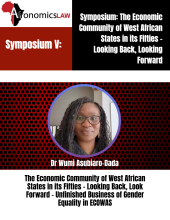
Symposium V: The Economic Community of West African States in its Fifties – Looking Back, Look Forward - Unfinished Business of Gender Equality in ECOWAS

In an ever-growing quest for gender equality, it is quite common for scholars and researchers to overlook regional and sub-regional systems while prioritizing global institutions, particularly the United Nations, its specialized agencies, and other international human rights mechanisms. The limited attention given to regional bodies stems from their perceived lack of influence in implementing meaningful reforms compared to global institutions. Unbeknownst to many, regional systems, despite their marginalization, have developed contextually relevant, progressive policy documents and delivered consequential legal judgments on women's rights. However, as is the case with many international, regional or sub-regional organizations, the perennial challenges remain the translation of the policies and enforcing the far-reaching judgements on women’s rights. The Economic Community of West African States (ECOWAS) embodies this paradox.

Book Review III: Taxation, Human Rights and Sustainable Development: Global South Perspectives (Routledge, 2025) - A Review

Emerging literature has established that there is a link between taxation and human rights. However, the nature of this link, the existence (or absence) of a coherent normative framework, and how taxation can be leveraged to foster the realization of socioeconomic rights have preoccupied the discussions in the literature. Notably, very few conversations in the literature have exclusively focused the discussion on taxpayers’ perspective in the global south. This is precisely the gap addressed by Taxation, Human Rights, and Sustainable Development: Global South Perspectives, edited by Eghosa O. Ekhator, Newman U. Richards, and Chisa Onyejekwe, and published by Routledge in 2025. As this review will demonstrate, this book makes a significant and timely contribution to the literature for several important reasons.

Book Review Symposium Introduction: The Transnational Land Rush in Africa

This symposium opens up our book to examination, reflections and critical perspectives from experts such as Lorenzo Cotula, Nisrin Elamin, Wegayehu Fitawek and Kariuki Kirigia. As shown in their contributions, these discussants offer a depth of knowledge as well as passion for orienting people before profit.