
ECOWAS Court of Justice

Symposium VII: The Economic Community of West African States in its Fifties – Exploring Implied Consent to Treaties as the Basis of the ECOWAS Court’s Jurisdiction over Member States that are not Signatories or Parties to the Court’s Protocols

Under the relevant rules of the law of treaties as provided for in Article 11 of the Viena Convention on the Law of Treaties (VCLT), a state’s consent to be bound by a treaty “may be expressed by signature, exchange of instruments constituting a treaty, ratification, acceptance, approval or accession, or by any other means if so agreed.” It appears from the text of Article 11 of the VCLT that expression of consent to a treaty must generally be by means of an express or overt act, notice of which must be given, or received by, the other parties to the treaty. In contrast to the above legal position, the practice of some ECOWAS Member States in relation to Protocols governing the ECOWAS Court of Justice raises the question of whether a state’s consent to be bound by a treaty may be implied from its conduct. Of particular interest in this regard, is the Republic of Cape Verde. This essay seeks to determine whether the concept of implied consent could offer a conceptual justification for the exercise of the ECOWAS Court’s jurisdiction over Member States that have either not signed or ratified the relevant Protocols governing the Court’s jurisdiction.
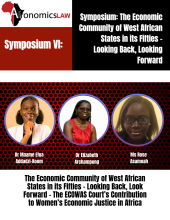
Symposium VI: The Economic Community of West African States in its Fifties – Looking Back, Look Forward - The ECOWAS Court’s Contribution to Women’s Economic Justice in Africa

Promoting economic cooperation and development among Member States has been the primary aim of the Economic Community of West African States (ECOWAS) since its inception in 1975. Unsurprisingly, in the beginning, the Community’s only judicial body, the ECOWAS Court, only had a mandate to foster socio-economic integration. Consequently, when the Court was granted a human rights mandate in 2005, it was expected that advancing economic justice and safeguarding economic rights would underpin its adjudicatory functions. The economies of countries in West Africa exhibit a significant gender gap, which manifests in various ways, including the gender pay gap, women disproportionately engaged in informal and vulnerable employment, unequal access to job opportunities, occupational segregation, unequal asset ownership, limited access to financial services, and unpaid care work.In this blog post, we provide a brief overview of two cases decided by the ECOWAS Court that concern women’s rights to work, showcasing the Court’s role in promoting women’s economic justice in the West African sub-region and beyond. However, before discussing these cases, which inform our conclusions, we briefly explore the nature of the right to work for women within the African human rights system.

Those Who Serve a Revolution Plough the Sea: Ghanaian Market Traders and their Resistance to the ECOWAS Supranational Order

The Economic Community of West African States (ECOWAS) Revised Treaty of 1993 is supposed to be the basis of a legal revolution that ended its members’ sovereignty and create a regional order that mirrored the European Union’s (EU) successful supranationalism. Departing from its 1975 Treaty ECOWAS has been reconfigured as a new entity whose rules, under article 9 (4) are of direct and binding effect on its members – the essence of supranationalism.

Corporate Personality under International Law and Justice Gaps: Could Delocalisation Prompt a Potential Role Within African Regional Courts Frameworks?

There is the potential to create regional or sub-regional frameworks, which through agreements can handle claims against companies within their territories. This may strengthen local regional capacity, alleviate the allegations of complicity of the state and exemplify the cooperative spirit embodied in more recent collaborative African action. It would demonstrate an attempt at African solutions which are not dependent on home states. Nevertheless, it may not be enough to counter the lack of legally binding responsibility grounded in international law, as it would not be able to bring parent companies, who reside outside the African jurisdiction, within its scope.

The Performance of Africa's International Court: Book Review

The book is a robust piece of work that covers assessment of different subject matters in the East African Court of Justice (EACJ), the African Court of Human and People’s Rights, the defunct Southern African Development Community Tribunal, and the ECOWAS Community Court of Justice (the ECCJ). However, this review will centre on the chapters which focus on the ECCJ. This is not in any way a dismissal of chapters dedicated to other courts, it is simply in a bid to streamline this review and also a reflection of the specific research interest of the writer i.e. the quality of the ECCJ.

A Venue or a Decision Maker? The Constitutional Function of African Regional Courts

While exercising constitutional function, one  may suggest the use of some avoidance tactics discussed here. Doing justice in individual case might require court orders with robust remedies. How to master the splits? Clearly, the book does not only answer such pertinent research questions, it also opens new fields for research. It is a must read for everybody interested in regional integration, constitutional law and access to justice in Africa.

Human Rights Compatibility of Trade in WASH Services in the African Continental Free Trade Area

The main goal of the international HRWS is to prioritise universal access to safe, affordable, accessible, adequate water and sanitation, including hygiene services. The human rights framework also has procedural requirements to ensure non-discrimination, public participation, transparency and accountability and the extraterritorial obligation to do no harm in the governance of WASH services. Water is understood as having diverse characteristics being simultaneously an economic, social, cultural, political and ecological good. This multiplicity of framings complicates the localization and mainstreaming of the HRWS in relevant institutions at various levels of governance, from the international to the local.

Investor Responsibility towards Local Communities in Extractive Industry Projects in African Countries

Local communities, for their part, consider investor responsibility a necessary part of the fabric of international law and politics. While the AU works towards framing business and human rights in Africa along with global developments regarding a treaty on business and human rights and treaties such as the Morocco/Nigeria BIT, African peoples and communities continue to adopt available mechanisms as avenues for communicating their positions on these important issues and exercising agency on a subject that is of utmost importance to their wellbeing.