
One Hundred and Eighth Sovereign Debt News Update: Nigeria’s Public Debt to hit N95trn as Senate Approves President Tinubu’s Request to Securitise N7.3 trillion owed to the Central Bank

It remains imperative for both the executive and lawmakers to find the political will to push for judiciousness in debt management; thus, eliminating the danger of excessive and unproductive debt. The government of Nigeria must adopt responsible borrowing practices in order to arrive at a sustainable debt stock. As it stands, the Ways and Means advances facility may be prone to abuse if Presidents can easily approach the CBN for loans without repaying and transferring the burden to the average citizen. The AfSDJN recommends that the Tinubu administration only approaches the Central Bank as a “lender of last resort” in strict conformity with Section 38 (1) of the CBN Act. The Federal Government must devise more proactive ways of raising revenue to reduce such borrowing activities as it increases Nigeria’s debt servicing burden as highlighted. Convened by Afronomicslaw.org with the support of Open Society for Southern Africa, (OSISA), the AfSDJN's activities are tailored around addressing the threats that sovereign debt poses for economic development, social cohesion and human rights in Africa. It advocates for debt cancellation, rescheduling and restructuring as well as increasing the accountability and responsibility of lenders and African governments about how sovereign debt is procured, spent and repaid.
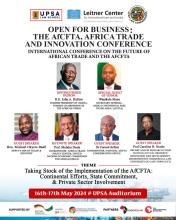

Call for Papers: Taking Stock of the Implementation of the AfCFTA: Continental Efforts, State Commitment and Private Sector Involvement, UPSA Law School, Accra, Ghana (Hybrid)

The sponsoring organizations of the International Conference on the Future of African Trade and the AfCFTA invite submissions and participant nominations for a collaborative exchange and discussion at a two-day hybrid conference to take place on May 16 and 17, 2024. The conference working language will be English and will include paper presentations on topics detailed below.

Webinar Invitation: The Future of International Investment Law in Africa - A Conversation on Two New Books

The webinar brings two together the authors of two new books on the subject of international investment law in Africa and three expert panelists to interrogate thematic issues that arise from the books; their implication for contemporary practices of international investment law in Africa and beyond; and what insights we may draw on them for the future of the regimes on investment law in Africa.

One Hundred and Seventh African Sovereign Debt News Update: Ghana’s Bilateral Creditors Close to Issuing Memorandum of Understanding

As Ghana navigates the complexities arising from its debt crisis, it is equally faced by a galloping inflation, a depreciating currency, a general decline in the quality of life coupled with the high cost of living. It has become clearer that the completion of the review and unlocking of the $600 million disbursement hinges on Ghana’s official creditors swiftly reaching an agreement on specific terms of debt treatment. The AfSDJN continues to urge the IMF to actively and urgently commence deliberations on a new comprehensive, fair and effective sovereign debt restructuring mechanism based in the United Nations that would be binding on all creditors, including commercial creditors, and that would make it difficult for hold-out creditors to prevent sovereign debt workouts.

Africa and the (Mis-)Promise of Green Finance

This post critiques the extent to which the present green finance rush embraces laws and policies that are largely externally motivated prescriptions designed, mandated, or foisted on resource-rich African countries through creative channels of geopolitical norm diffusion. These contradictions need to be questioned to avoid the charge of greenwashing.

Green Deals and Reproductive Justice: A Promise of Just Transition

Research has linked climate change and reproductive rights, as demonstrated by the increased exposure of women to sexual assault as they collect firewood or search for water. Such sexualized violence is prevalent in women-led rural households and highly vulnerable settings. For example, humanitarian contexts, slums, and arid areas have high rates of sexual violence due to water scarcity and poor lighting as women and adolescent girls travel long distances to access water. From an African socio-cultural context, fetching water and firewood are mainly feminine roles. Thus, energy distribution and water scarcity associated with climate change interact with gender dynamics to provide a setting for enacting sexualized violence. Freedom from sexual violence is an integral aspect of reproductive justice, a state where people have bodily autonomy and live in a safe and healthy environment that protects and upholds their reproductive rights and decisions. The question that arises is - can green projects, including the EU Green Deal, address climate change in a manner that addresses the associated sexual and reproductive justice issues in Sub-Saharan Africa?

Towards a United Nations Tax Convention: Prospects and Challenges for Developing Economies

This commentary highlights the prospects and challenges of a UN framework tax convention for developing economies and makes recommendations for mitigating risks. It argues that while the proposed UN framework tax convention may provide a broader forum for increased conversations between developed and developing countries on international cooperation in tax matters, it may not be the magic wand of equal participation in global tax policy formulation hoped for by developing countries. Nevertheless, the adoption of the UN tax resolution is indeed a very significant development in the international tax law and policy space that will form the basis of very engaging conversations in the coming years.

The Political Economy of the European Green Deal, Neoliberalism and the (Re)production of Inequalities

While the law is to a large extent responsible for the overlapping social and ecological breakdowns, translating the above-mentioned principles into law means creating legal frameworks (through the interpretation of existing legal rules and principles and the creation of new legal instruments) that move away from the primacy of market logics and extractive profit-oriented economies embedded in colonial legacies, and reproducing gendered and racialized inequalities. It requires designing legal responses that would enable transformative ways of thinking about economies, justice, and our relationship with the non-human worlds, while embedding law and policies in truly democratic frameworks and practices. It means centering within legal thinking and legal practices the multiple forms of exclusions that are pervasive within and outside the EU, and that EU laws and policies often directly enable. Making a fair and inclusive transition happen requires bold choices and unwavering principles. Right now, the EU is quite far from embracing and practicing them.

European Green Deal, EU’s Global Gateway, and Financing for (un)just green transitions

In this contribution, we demonstrate how the so-called Green Deals initiatives which espouse an increasing drive to “catalyze” private financing by using public resources, including development assistance, may create perverse impacts on sustainable development in developing countries. The move may mean an overarching shift towards reliance on private sector to provide public infrastructure and services in ways that ensure a return for the private sector through buy-back guarantees and favourable contractual conditions. Such moves may create contingent liabilities on developing countries in addition to diverting public resources towards the private sector, including foreign investors, and undermining public oversight.