
Environmental Sustainability

Symposium I: The Economic Community of West African States in its Fifties – Looking Back, Look Forward - Beyond Borders: Towards a Collaborative and Sustainable Maritime Future in West Africa
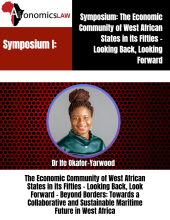
The ocean and its resources support many sectors vital to the West African region, including fisheries and aquaculture, maritime transport and shipping, maritime security, coastal and maritime tourism, sustainable energy, mineral resources, and emerging marine industries. Collectively, these sectors are called the “Blue Economy” (BE). The BE is a cornerstone of economic growth, sustainability, and security for the twelve coastal and island states and three land-linked countries in the region, providing livelihoods for millions and serving as a primary revenue source for coastal and island states. The BE contributes 56% of the GDP of coastal states in West Africa, underscoring its economic significance. With one-third of the region’s population residing in coastal areas, its ocean and resources are essential to food security, trade, and long-term resilience, making them a crucial driver of sustainable development in West Africa.
News: 10.20.2025

The News and Events category publishes the latest News and Events relating to International Economic Law relating to Africa and the Global South. Every week, Afronomicslaw.org receive the News and Events in their e-mail accounts. The News and Events published every week include conferences, major developments in the field of International Economic Law in Africa at the national, sub-regional and regional levels as well as relevant case law. News and Events with a Global South focus are also often included.

Research Assistant (Person Specification) - Debt for Nature Swaps (D4N) in Africa

March 25, 2024

Research Assistant Person Specification

Position Title: Research Assistant

Project Focus: Debt for Nature Swaps (D4N) in Africa

Overview:

The Research Assistant will work closely with the supervising senior academic (Consultant) to conduct data collection and analysis for a project examining the landscape of D4N in Africa.

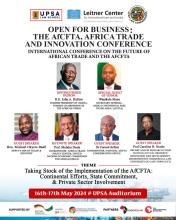
Call for Papers: Taking Stock of the Implementation of the AfCFTA: Continental Efforts, State Commitment and Private Sector Involvement, UPSA Law School, Accra, Ghana (Hybrid)

The sponsoring organizations of the International Conference on the Future of African Trade and the AfCFTA invite submissions and participant nominations for a collaborative exchange and discussion at a two-day hybrid conference to take place on May 16 and 17, 2024. The conference working language will be English and will include paper presentations on topics detailed below.

International Investment Law: National, Regional and Global Perspectives Book Symposium

I am delighted to present this symposium for my textbook entitled: International Investment Law: National, Regional and Global Perspectives (Wolf Legal Publishers, Nijmegen, the Netherlands: 2020). The textbook could not have come at a better time given the compelling need for scholars from the Global South, particularly Africa, to contribute to international investment law scholarship to help reshape and redefine international investment law for the mutual advantages of foreign investors/enterprises and the host States.

Beyond GVCs as clockworks: The constitutive role of law, power and the way(s) ahead

Global Value Chains (GVCs) are the main form of contemporary transnational capitalism. They are complex legal and financial structures that challenge traditional international-national and public-private dichotomies. They shape and define the speed of work and extraction, build bridges, raise walls, and transform lives and nature in each place where they touch base around the globe. Covid-19, a biological shock that has triggered a legal and economic reconsideration of global markets, has revealed the ecological backbone of value chains and highlighted the need to rethink the premises of competitiveness and cheapness around which they are imagined.

Review II: Energy Poverty and Access Challenges in Sub-Saharan Africa: The Role of Regionalism

Access to energy is an important part of the everyday survival of modern humankind. However, not all energy forms are healthy for humans and the environment. Given that different countries have various degrees of endowment in energy resources and varied energy needs, cooperation is important for addressing the individual challenges of nations. An interesting contribution of the book is the in-depth review of the renewable energy potential in SSA while highlighting the basic requirements for tapping the full potential of these sources

How Public Interest Litigation Led to Invalidation of Illegal Mozambican Debt

The Mozambican case of odious debt is an illustration of several similar cases around the world whereby consultants from multinational corporations identify development countries with something of value, such as minerals, and persuade the authorities of these countries to secretly take on huge development loans with banks. In most cases, the money never reaches the countries. Rather, the money is transferred directly from the banks to contractors and the countries are then left with massive debts. Resources and companies from developing countries are given as collaterals for these loans. Therefore, the resources that countries should use to invest in development are transferred to service these odious debts. In summary, this is what happened in Mozambique.