
June 21, 2026
1. Introduction
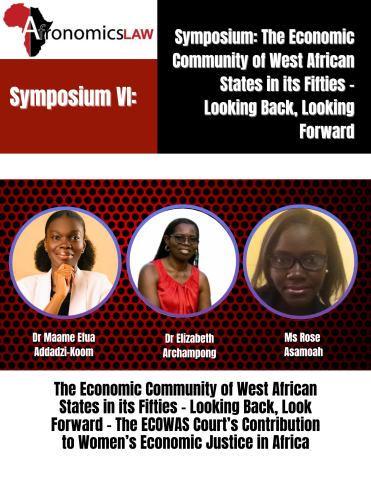
Promoting economic cooperation and development among Member States has been the primary aim of the Economic Community of West African States (ECOWAS) since its inception in 1975. Unsurprisingly, in the beginning, the Community’s only judicial body, the ECOWAS Court, only had a mandate to foster socio-economic integration. Consequently, when the Court was granted a human rights mandate in 2005, it was expected that advancing economic justice and safeguarding economic rights would underpin its adjudicatory functions. The economies of countries in West Africa exhibit a significant gender gap, which manifests in various ways, including the gender pay gap, women disproportionately engaged in informal and vulnerable employment, unequal access to job opportunities, occupational segregation, unequal asset ownership, limited access to financial services, and unpaid care work. Although the African Charter on Human and Peoples’ Rights required that member states eliminate discrimination against women and protect their human rights, the need to guarantee more specific rights for women led, in 2003, to the African Union’s adoption of the Protocol to the African Charter on Human and Peoples’ Rights on the Rights of Women in Africa (the Maputo Protocol). The Maputo Protocol provides a legal framework for holding African states accountable for the violation of a wide range of women’s rights. The Protocol to the African Charter on Human and Peoples’ Rights on the Rights of Women in Africa (Maputo Protocol), the bill of rights for African women, in Article 13 provides substantial protections for women’s economic rights by requiring states to adopt and enforce legislative and other measures to ensure women have equal opportunities in employment, career progression, and other economic spheres. However, beyond these legal safeguards, effective adjudication of the rights outlined is essential to narrowing the economic gender gap. The ECOWAS Court, as a sub-regional judicial authority, plays a vital role in shaping African women’s economic rights through its decisions, thereby contributing to the achievement of economic equality. In particular, the right to work—encompassing equal access to employment, transparency in recruitment, promotion, and dismissal, as well as the related right to be free from sexual harassment in the workplace—has been the focus of adjudication in the ECOWAS Court.
In this blog post, we provide a brief overview of two cases decided by the ECOWAS Court that concern women’s rights to work, showcasing the Court’s role in promoting women’s economic justice in the West African sub-region and beyond. However, before discussing these cases, which inform our conclusions, we briefly explore the nature of the right to work for women within the African human rights system.
2. The Nature of Women’s Right to Work in the African human Rights System
Article 13 of the Maputo Protocol ) the Bill of Rights for African Women, addresses the right to work as part of a broader set of socio-economic rights. Article 13, like all other provisions in the Maputo Protocol, is based on substantive equality rather than formal equality. Substantive equality seeks to achieve equal outcomes, whereas formal equality emphasises similar treatment. Understanding that Article 13 is founded on substantive rather than formal equality is essential to fully appreciate the rights it guarantees. Substantive equality’s focus on equal outcomes involves four key aspects: addressing disadvantages instead of merely ensuring gender neutrality, tackling issues such as stigma, stereotyping, humiliation, and violence based on gender, recognising how societal structures reinforce women’s disadvantages, and valuing women’s agency and voice as critical for advancing socio-economic rights essential for women’s empowerment.
Women’s right to work, as outlined in Article 13, includes equal access to employment, equal pay for work of equal value, transparency in recruitment, promotion, and dismissal processes, as well as the fight against and punishment of sexual harassment in the workplace. States are required to ensure that women are free to choose their occupation and are protected from exploitation by their employers. The informal sector is not excluded. Under Article 13(e), states are to create conditions to promote and support women’s occupations and economic activities within the informal sector. Furthermore, Article 13(f) obliges states to establish a system of protection and social insurance for women working in the informal sector and to raise awareness among them to adhere to such systems. The girl-child is also covered by Article 13, which requires states to introduce a minimum age for work and prohibit employment of children below the set age, and to punish all forms of exploitation connected to them. The article also calls for the economic value of unpaid domestic work, which is usually the preserve of women, to be recognised. In both the public and private sectors, women are entitled to adequate and paid pre- and post-natal maternity leave. Taxation laws are also to be applied equally to women and men. States are also to recognise and enforce the right of salaried women to the same allowances and entitlements as those granted to salaried men for their spouses and children.
Despite the promising guarantees for women’s right to work in the Maputo Protocol, Article 13 has not yet been the subject of a case before the ECOWAS Court. Nevertheless, the ECOWAS Court has, in two decided cases, established its jurisprudence regarding aspects of women’s rights to work and their connection to state responsibility. We analyse these two cases in the next section.
3. The ECOWAS Court’s Adjudication of Women’s Right to Work in Public Service
In Aircraftwoman Beauty Igbobie Uzezi v. The Federal Republic of Nigeria and Dame Medagbe Rita v. Republic of Togo, the ECOWAS Court had to determine issues regarding women’s right to work.
In Uzezi, a young female employee of the Nigerian Air Force who had been raped and physically assaulted by a male colleague was subsequently unlawfully dismissed without trial, contrary to the procedure in the Armed Forces Act. She claimed her unlawful dismissal violated her right to work. Since her allegation was against the state, given that the Nigerian Air Force was an agency of the state, the Court first had to establish the meaning of the right to work in relation to the state’s obligation. The ECOWAS Court explained that the right to work does not require the State to prevent unemployment or guarantee jobs. Instead, it obligates the State not to deprive someone of a job once it’s secured unfairly. To prove a violation of the right to work, therefore, three elements must be proven: (a) that there was an employment, (b) it was terminated, and (c) the termination was unlawful. Based on these three elements, the Court found Ms. Uzezi’s right to work in the Air Force had been violated by Nigeria. The Court’s determination in Uzezi aligns with Article 13(c) of the Maputo Protocol, which requires transparency in dismissal and the prevention, combating, and punishment of sexual harassment in the workplace . For the ordinary Nigerian, the Uzezi decision served as a call to action for the government to do better for women. Describing the unlawful dismissal of Ms. Uzezi as “the tacky handling of the victim’s dismissal,” a media outlet condemned Nigeria’s stance in the case, noting that ‘the victim must have gone to the sub-regional court as a last resort, and with this comes very dire regional and continental implications for Nigeria. Nigeria is the poster child of Africa and must behave in ways that are worthy of its global reputation as the ‘giant of Africa’. The media outlet also pointed out that the unlawful dismissal was more than just the state’s attitude towards women’s right to work; it reflected Nigeria’s posture toward female victims of sexual violence and abuse: ‘The fact that the victim did not get justice but was verbally dismissed from the Nigerian Air Force (NAF) in October 2015 is an eloquent example of how such sexual and other domestic violence against women are handled in Nigeria.’
In Medagbe, the applicant, a schoolteacher who had remained at the same grade level for over 21 years, argued that her rights to equal access and treatment in the Togolese public service had been breached, as well as her rights to fair and equal remuneration and to receive retirement benefits. The ECOWAS Court found only one of the five claimed violations to be proven, specifically her right to equal treatment in public service due to the differential treatment of not being granted tenure or being dismissed after completing a one-year probation period, which ultimately kept her at the same grade level for over 21 years.
The Court further clarified each of the four other work-related rights that it found were not violated. According to the Court, the right to equal access meant that all citizens must have access to public service under the same conditions, without any discrimination based on social status, race, ethnicity, political opinions, or religion. In Medagbe, the Court did not find a breach of this right to equal access because it did not identify any discriminatory measure restricting the applicant’s access; rather, it concluded that her own inaction was responsible for her lack of access. The applicant’s claim to her right to be nominated for a permanent position in the Togolese administration was interpreted by the Court as imposing on states the obligation to not only guarantee their citizens’ right to work but also to uphold it by preventing the worker from falling into a situation of precariousness that could threaten her enjoyment of that right. For Ms. Medagbe, the Court did not find this right violated because she held a permanent position—albeit of a lower grade—and there was no evidence to suggest that this position was under threat or had been interrupted during the 21 years she remained at that level. Her right to a fair wage and equal remuneration was also not deemed to have been violated, as her salary was consistent with her grade within the public service. Finally, Ms. Medagbe’s rights to career advancement, promotion in public service, and retirement benefits were considered not violated due to a lack of evidence.
The Medagbe case involved five variations of the right to work that align with the rights stipulated in Article 13, namely, the right to equality of access to employment (Article 13(a)), the right to equal remuneration for jobs of equal value (Article 13(b)), and the right to transparency in recruitment, promotion, and dismissal (Article 13(c)).
Although the ECOWAS Court did not refer to Article 13 in either case, it clarified the nature and scope of certain aspects of the right to work in the public service as it relates to state responsibility. A key interpretation the Court provided is that the right to work does not impose an obligation on states to guarantee employment for their citizens or prevent their citizens from getting employed. Instead the right to work only requires states to ensure that once citizens secure jobs, they are not unjustly deprived of them. Additionally, it obliges states to refrain from threatening or interfering with citizens' employment, allowing them to retain or maintain their jobs as part of their right to work. Moreover, to hold a state accountable for breaching the right to work, a person must have been employed in the public service and unlawfully dismissed. Therefore, unemployed women or dismissed female employees may not automatically establish violations of the right to work against their states unless they meet the various threshold requirements established by ECOWAS Court precedent in Uzezi and Medagbe cases.
4. Conclusion
Women’s right to work is just one aspect of their economic rights, and their right to work in the public service is only a subset of the many sectors where women participate in employment. While the jurisprudence on the right to work established by the ECOWAS Court may be relevant to the private and informal sectors, its explicit application mainly concerns the public sector, which is within the domain of states. The non-public sectors involve complexities that can make holding states accountable for work-related violations unpredictable, but not impossible. However, the African Continental Free Trade Area (AfCFTA) women’s rights regime, established through the Protocol on Women and Youth in Trade, offers a potential opportunity for the ECOWAS Court to adjudicate cross-border trade issues affecting women in the future. These cross-border trade issues include cases related to formalising the informal sector (which is dominated by women), thereby promoting economic justice for women through adjudication beyond the usual scope of the public sector, which has traditionally been the sole realm for making states liable. Nevertheless, the precedents from the public sector provide a foundation to build on, which is a significant contribution by the ECOWAS Court to the quest for African women’s economic justice.