Gender Equality

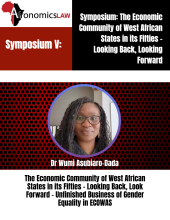
Symposium V: The Economic Community of West African States in its Fifties – Looking Back, Look Forward - Unfinished Business of Gender Equality in ECOWAS

In an ever-growing quest for gender equality, it is quite common for scholars and researchers to overlook regional and sub-regional systems while prioritizing global institutions, particularly the United Nations, its specialized agencies, and other international human rights mechanisms. The limited attention given to regional bodies stems from their perceived lack of influence in implementing meaningful reforms compared to global institutions. Unbeknownst to many, regional systems, despite their marginalization, have developed contextually relevant, progressive policy documents and delivered consequential legal judgments on women's rights. However, as is the case with many international, regional or sub-regional organizations, the perennial challenges remain the translation of the policies and enforcing the far-reaching judgements on women’s rights. The Economic Community of West African States (ECOWAS) embodies this paradox.

Migration-Development Nexus through a Gender Lens

It has been 25 years since Sen’s seminal book “Development as Freedom” was published. A lot has changed since then, also in terms of how we tend to perceive the relationship between migration and development. For one, and to paraphrase Sen, migrants have begun to be perceived as “responsible persons” who “chose to act one way rather than other”. To migrate, or to stay. This reasoning is reflected in the recent work of, among others, Hein de Haas (2021) and Kerilyn Schewel (2020), who perceive migration – or lack thereof – as a result of people’s aspirations both in terms of their right to move (de Haas) and to stay (Schewel). Importantly, as argued by the latter, a systematic neglect of the causes and consequences of immobility – i.e. of people’s staying preferences – obscures any efforts to understand why, when, and how people migrate. By developing the aspirations-capabilities frameworks to explore the determinants of (im)mobility, de Haas and Schewel have contributed a great deal to altering the status quo in migration research, which has often focused on the more easily quantifiable, economic factors underlying migration decision-making. Importantly, unlike most mainstream theories of migration, the aspirations-capabilities framework becomes even more relevant when acknowledging the highly gendered nature of migration.

News: 3.14.2024

The News and Events category publishes the latest News and Events relating to International Economic Law relating to Africa and the Global South. Every week, Afronomicslaw.org receive the News and Events in their e-mail accounts. The News and Events published every week include conferences, major developments in the field of International Economic Law in Africa at the national, sub-regional and regional levels as well as relevant case law. News and Events with a Global South focus are also often included.

NEWS: 06.01.2023

The News and Events category publishes the latest News and Events relating to International Economic Law relating to Africa and the Global South. Every week, Afronomicslaw.org receive the News and Events in their e-mail accounts. The News and Events published every week include conferences, major developments in the field of International Economic Law in Africa at the national, sub-regional and regional levels as well as relevant case law. News and Events with a Global South focus are also often included.

A Review of the Role of Women Leadership in Facilitating Regional Integration in Africa: The Way Forward

An efficient and effective regional integration in Africa is impossible without the inclusion of women.” Since time immemorial, African women have engaged in trade and are agents of development in formal and informal sectors. Women constitute half of the world’s population, with more than 70 percent of cross-border trade being conducted by women. These women are not a homogenous group and have different experiences. Therefore, it is essential that women, as the subject of policy, spearhead regional integration in Africa. This paper asserts that one of the reasons for the stagnated pace of regional integration in Africa is due to the failure to include women in the regional integration process.

FDI and Gender Equality in Kenya: A Double-edged Sword?

There is a relationship between Foreign direct investment (FDI) and gender (in)equality. This relationship is premised on two assumptions. The first is that FDI contributes to gender equality, and the second is that FDI may indeed be the shackle to gender equality. The first assumption is more popular than the second as its reality is more visible to the public compared to the second. In evaluating the first assumption, it is undeniable that FDI is one of the factors that contribute to the economic growth of a country as it adds to a country’s capital stock. Studies have shown a positive relation between FDI and the Gender Development Index (GDI). Based on these studies, an inference is drawn that there is an increase in gender equality as a result of more FDI

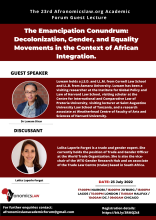
23rd Academic Forum Guest Lecture: The Emancipation Conundrum: Decolonization, Gender, and Equality Movements in the Context of African Integration

The Academic Forum is an inclusive and accessible forum that brings together undergraduate and graduate students as well as early career researchers from across the world interested in international economic law issues as they relate to Africa and the Global South. Its goals are to encourage and build core research skills in teaching, research, theory, methods and writing; developing content for Afronomicslaw.org and where possible to encourage authors to submit to the African Journal of International Economic Law; holding workshops and masterclasses on core research skills in teaching, research, theory, methods and writing; and organizing annual poster/essay competitions on international economic law issues.

Symposium on Early Career International Law Academia: Gender Disparity in Academic Citations: Tips for Rectifying the Gender Gap among Early Career International Law Academics and Practitioners

The impetus for this blog post was the excellent book Invisible Women by Caroline Criado-Perez. Among other things, the book highlights evidence for the existence of a gender gap in the frequency of citations: plainly, women are cited much less than men in academic works. I would argue that this gender gap is likely to be equally pervasive in the context of international legal scholarship, and particularly prejudicial to junior women practitioners and early career researchers (“ECRs”). With this phenomenon in mind, this piece proceeds in three parts. First, it reviews the more general evidence for the existence of a gender gap in academic citations and legal scholarship. Second, it provides a personal perspective by reviewing gender equality in my own citation practice. Finally, it concludes by recommending best practices to minimize the gender gap, with an emphasis on the role of ECRs.

Book Review: The Emergent African Union Law: Conceptualisation, Delimitation and Application. Olufemi Amao, Michèle Olivier and Konstantinos D. Magliveras (eds)

This substantial volume sets out to establish the case for recognition of a new field of law. The editors propose a concept of African Union (AU) law – by analogy with the established body of European Union (EU) law – and argue for the need for such a concept in order to create “a platform to examine legal developments in Africa from an Afrocentric perspective”.