
ECOWAS Court

Symposium VII: The Economic Community of West African States in its Fifties – Exploring Implied Consent to Treaties as the Basis of the ECOWAS Court’s Jurisdiction over Member States that are not Signatories or Parties to the Court’s Protocols
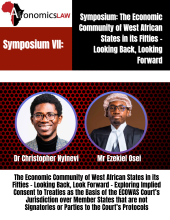
Under the relevant rules of the law of treaties as provided for in Article 11 of the Viena Convention on the Law of Treaties (VCLT), a state’s consent to be bound by a treaty “may be expressed by signature, exchange of instruments constituting a treaty, ratification, acceptance, approval or accession, or by any other means if so agreed.” It appears from the text of Article 11 of the VCLT that expression of consent to a treaty must generally be by means of an express or overt act, notice of which must be given, or received by, the other parties to the treaty. In contrast to the above legal position, the practice of some ECOWAS Member States in relation to Protocols governing the ECOWAS Court of Justice raises the question of whether a state’s consent to be bound by a treaty may be implied from its conduct. Of particular interest in this regard, is the Republic of Cape Verde. This essay seeks to determine whether the concept of implied consent could offer a conceptual justification for the exercise of the ECOWAS Court’s jurisdiction over Member States that have either not signed or ratified the relevant Protocols governing the Court’s jurisdiction.
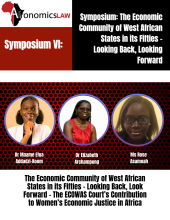
Symposium VI: The Economic Community of West African States in its Fifties – Looking Back, Look Forward - The ECOWAS Court’s Contribution to Women’s Economic Justice in Africa

Promoting economic cooperation and development among Member States has been the primary aim of the Economic Community of West African States (ECOWAS) since its inception in 1975. Unsurprisingly, in the beginning, the Community’s only judicial body, the ECOWAS Court, only had a mandate to foster socio-economic integration. Consequently, when the Court was granted a human rights mandate in 2005, it was expected that advancing economic justice and safeguarding economic rights would underpin its adjudicatory functions. The economies of countries in West Africa exhibit a significant gender gap, which manifests in various ways, including the gender pay gap, women disproportionately engaged in informal and vulnerable employment, unequal access to job opportunities, occupational segregation, unequal asset ownership, limited access to financial services, and unpaid care work.In this blog post, we provide a brief overview of two cases decided by the ECOWAS Court that concern women’s rights to work, showcasing the Court’s role in promoting women’s economic justice in the West African sub-region and beyond. However, before discussing these cases, which inform our conclusions, we briefly explore the nature of the right to work for women within the African human rights system.