
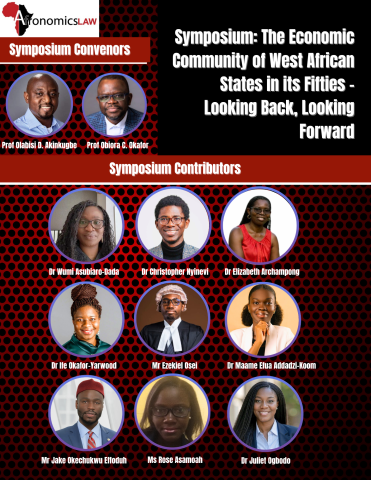
May 28, 2026
The Economic Community of West African States (ECOWAS), perhaps the most successful regional economic community in Africa, at least until recently, turns fifty-one (51) on May 28, 2026. ECOWAS, which was established on 28 May 1975 was tasked with the goal of promoting economic and political integration among its member states. Specifically, ECOWAS Treaty offers a key summary of its vision: “promoting co-operation and integration, leading to the establishment of an Economic Union in West Africa in order to raise the living standards of the peoples, and to maintain and enhance economic stability, foster relations-among Member States and contribute to the progress and development of the African Continent.”
ECOWAS is among the eight (8) regional economic communities (RECs) recognized by the African Union and is regarded as one of the most successful such bodies in Africa. Consequently, its development over the past five decades offers valuable lessons for the past, present, future of regional integration in Africa.
After an initial era that was dominated by various political and social conflicts, as well as institutional inertia, the treaty establishing ECOWAS was revised. The revamped ECOWAS Treaty of 1993 heralded the second era of ECOWAS with the creation of key institutions such as the ECOWAS Community Court of Justice, the ECOWAS Commission and the ECOWAS Parliament, among others, to strengthen and complement that REC’s existing governance architecture. With special agencies such as West African Monetary Agency, West African Monetary Institute, ECOWAS Youth and Sports Development Centre, ECOWAS Gender Development Centre, ECOWAS Brown Card, The West African Power Pool, ECOWAS Centre for Renewable Energy and Energy Efficiency, ECOWAS Regional Competition Authority, ECOWAS Regional Electricity Regulatory Authority, ECOWAS Intergovernmental Action Group against Money Laundering (GIABA), and the Regional Agency for Agriculture and Food.
The revision of the ECOWAS Treaty in 1993 brought about major changes to the integration and development agenda: (i) the strengthening of decision-making bodies; (ii) the establishment of appropriate mechanisms for conflict prevention and resolution; (iii) the broadening of the scope of the integration process and of regional cooperation, notably on key sectors such as peace and security, monetary integration, industrial cooperation, private sector and the environment.
ECOWAS’ Vision 2050, which followed ECOWAS Vision 2020, and seeks to consolidate on the progress of the organization with the mantra – ECOWAS of the Peoples: Peace and Prosperity for All, creates a bold and ambitious target for the community across regional, continental and global levels. This new vision takes account of the ongoing “4th Industrial Revolution” marked by the digitalization of economies and the developmental transformations that it generates.
The celebration of ECOWAS’ 50th anniversary in 2025 and its upcoming 51st in May 2026 happens amid deep regional divisions, democratic backsliding, a fragmented international economic order, geopolitical and climate-related crises and social conflicts, as well as waning interest in multilateralism. Yet, ECOWAS has also contributed to significantly (even immensely in some cases) to the promotion of democracy, conflict resolution and stabilization, and the freer movement of persons. It has also marched significantly toward the goals of a legislating community parliament and a robust community court. Importantly, the challenges facing ECOWAS and the successes it has enjoyed must be viewed against the background that, in the wider African context, ECOWAS is one of the key regional building blocks of the African Continental Free Trade Agreement. Consequently, despite the uncertainty of this era, RECs such as ECOWAS remain central to trade policy advancement in African contemporary era.
Yet, worryingly, in areas, such as intra-regional trade within ECOWAS, the progress made so far remains relatively low (around 10% of total external trade). When it comes to trading, ECOWAS member countries are still more integrated with European, and increasingly with Asian nations, rather than with each other. Further, the ECOWAS common external tariff has largely been ineffective due to the lack of unity in responding to the free trade deals that the European Union (EU) has negotiated individually with each ECOWAS member country. Also, the significant project aimed at creating a single currency issued by a regional central bank has been postponed multiple times. In the Sahel, terrorism, amid foreign military presence and interventions, has created fertile ground for military coups and wreaked havoc on civilians.
ECOWAS has also confronted internal membership crisis. Challenges with some Sahel states have driven ECOWAS into an existential crisis. Mali, Burkina Faso, and Niger have now withdrawn their membership of the community. The military leaders of these three nations have established the Alliance of Sahel States (AES); a confederation centered on a mutual defence agreement and enhanced coordination of economic policies.
Amidst a murky record of implementation of its objectives, different scholars have assessed the performance of ECOWAS in stark terms of failure and success. In this symposium, we have invited leading scholars of different emerging and traditional areas of scholarship – such as the blue economy, gender, digital justice and online dispute resolution, intellectual property rights, the ECOWAS Commission – to reflect of the ECOWAS’ performance from a more nuanced approach.
The first contribution in the symposium by Ife Okafor-Yarwood, is titled Beyond Borders: Towards a Collaborative and Sustainable Maritime Future in West Africa. Okafor-Yarwood examines how ECOWAS can transition from an “ECOWAS of States” to an “ECOWAS of the People”, as enshrined in its Vison 2050, by strengthening regional collaboration to build a shared maritime future that drives sustainable growth, employment, and security in West Africa. First, she explores the key challenges and threats to a sustainable blue economy and maritime security before proposing solutions that leverage regional trade and security agreements. She concludes by highlighting how rethinking the current approach to regional cooperation on trade and security can reinforce the realization of ECOWAS’s vision of a people-centered community.
The second contribution by Kofi Oteng-Kufour, entitled The Ecowas Commission: The Road to Significance, takes on an under-explored aspect of the ECOWAS governance infrastructure. Oteng-Kufour explores the growth and development of administrative power in ECOWAS. The essay contributes to the current limited body of knowledge on this aspect of ECOWAS by sketching the outlines of the ideas that have moulded the ECOWAS administrative apparatus.
The third contribution by Juliet Ogbodo ECOWAS and Intellectual Property Rights: Reflections and Future Prospects focus on an increasingly important and arguably underexplored aspect of ECOWAS’s economic development agenda: intellectual property rights (IPR) protection. As Ogbodo notes, in a knowledge-driven economy, IPR can play a meaningful role in fostering innovation, attracting investment, and strengthening local industries. While there have been some regional discussions and initiatives, IPR has not always featured prominently in ECOWAS’s broader integration efforts. As global and continental frameworks like the AfCFTA Protocol on Intellectual Property continue to evolve, this may be an opportune moment for ECOWAS to engage more deliberately with the IP agenda. Her contribution therefore considers how the organization has approached IPR so far and suggests potential areas for deeper focus going forward.
The fourth contribution by Jake Okechukwu Effoduh titled ECOWAS in the Next 50 Years: Advancing Regional Community Law through Digital Justice and Online Dispute Resolution reflects on a primary question: what can digital justice realistically improve at the ECOWAS Court, and what barriers will remain even with digitization? Effoduh argues that digital tools such as electronic case management systems, remote filing and hearings, automated notifications, and publicly accessible compliance dashboards can meaningfully reduce procedural delay, lower access costs, and strengthen transparency around state behavior. Bearing the structural limits which these digital tools operate in mind, Effoduh argues that digital justice should be “understood as a mechanism for enhancing administrative and procedural effectiveness, and for increasing the visibility of non-compliance, rather than as a solution to the Court’s deeper political economy of enforcement. In this sense, the promise of digital justice at the ECOWAS Court is best framed as conditional and complementary.
The fifth post by Wumi Asubiaro-Dada reflects on the Unfinished Business of Gender Equality in ECOWAS. Asubiaro-Dada explores what she describes as a duality: “ECOWAS as both a site for advancing gender equality and a spectre of the unfinished business of gender equality.” She explores this by focusing on three key dimensions: the extent of gender representation within ECOWAS’s formation and leadership structures, the organization’s influence on gender-related policies in member states, and the broader implications of ECOWAS’s gender policies on women's socio-political and economic empowerment in West Africa.
In a similar vein, the sixth post by Maame Efua Addadzi-Koom, Elizabeth Archampong & Rose Asamoah titled The ECOWAS Court’s Contribution to Women’s Economic Justice in Africa, explores the nature of the right to work for women within the African human rights system. The authors' focus on a brief overview of two cases decided by the ECOWAS Court that concern women’s rights to work, showcasing the Court’s role in promoting women’s economic justice in the West African sub-region and beyond.
The seventh and final contribution by Christopher Nyinevi and Ezekiel Osei titled Exploring Implied Consent to Treaties as the Basis of the ECOWAS Court’s Jurisdiction over Member States that are not Signatories or Parties to the Court’s Protocols, takes on another under-explored procedural aspect of the ECOWAS Court. Drawing on selected jurisprudence of the ECOWAS Court, Nyinevi and Osei’s essay reflects on whether the concept of implied consent could offer a conceptual justification for the exercise of the ECOWAS Court’s jurisdiction over Member States that have either not signed or ratified the relevant Protocols governing the Court’s jurisdiction.
We hope you enjoy the essays in this symposium!