Economic Policy

Symposium II: The Economic Community of West African States in its Fifties – Looking Back, Look Forward - The ECOWAS Commission: The Road to Significance

The Economic Community of West African States (ECOWAS) is a central actor in the law, politics and economics of the West African sub-region. Under article 3 of the ECOWAS Revised Treaty, ECOWAS aims to deepen and strengthen relations between its members with the aim of promoting co-operation and integration, leading to the establishment of an economic union in West Africa. This goal, if ever attainable, depends considerably on the role and power of its treaty organs, including its administrative organs, strengthening the ECOWAS legal order and thus underscoring ECOWAS relevance and power. This aim suggests the need for scholars of ECOWAS to focus attention on organs that they have largely neglected. This submission explores the growth and development of administrative power in ECOWAS. I seek to contribute to the current limited body of knowledge on this aspect of ECOWAS by sketching the outlines of the ideas that have moulded the ECOWAS administrative apparatus

Symposium Introduction: The Economic Community of West African States (ECOWAS) in its Fifties – Looking Back, Looking Forward

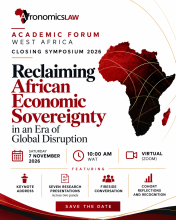
The Economic Community of West African States (ECOWAS), perhaps the most successful regional economic community in Africa, at least until recently, turns fifty-one (51) on May 28, 2026. ECOWAS, which was established on 28 May 1975 was tasked with the goal of promoting economic and political integration among its member states. Specifically, ECOWAS Treaty offers a key summary of its vision: “promoting co-operation and integration, leading to the establishment of an Economic Union in West Africa in order to raise the living standards of the peoples, and to maintain and enhance economic stability, foster relations-among Member States and contribute to the progress and development of the African Continent.”

Sovereign Debt News Update No. 171: Nigeria to Explore a $5 billion Total Return Swap with UAE Bank

Nigeria is once again at a critical juncture in its debt trajectory, as mounting fiscal pressures, rising borrowing costs, and constrained access to conventional financing channels push the government toward increasingly complex and opaque instruments. Recent reports indicate that Nigeria is considering a $5 billion Total Return Swap (TRS) arrangement with First Abu Dhabi Bank, marking a significant shift in its debt management strategy. This development must be situated within a broader pattern of an increasing appetite for this credit derivative in the form of Total Return Swaps. Both Angola and Senegal have in the recent past also been reported to have entered into Total Return Swaps. These developments point to a deepening reliance on financial engineering solutions that may provide short term liquidity but carry significant long-term risks for fiscal stability and public accountability.

Sovereign Debt News Update No. 168: Zimbabwe Announces Immediate Suspension of Raw Mineral and Lithium Exports: Implications for the Global Lithium Market

The African Sovereign Debt Justice Network, (AfSDJN), is a coalition of citizens, scholars, civil society actors and church groups committed to exposing the adverse impact of unsustainable levels of African sovereign debt on the lives of ordinary citizens. Convened by Afronomicslaw.org with the support of Open Society for Southern Africa, (OSISA), the AfSDJN's activities are tailored around addressing the threats that sovereign debt poses for economic development, social cohesion and human rights in Africa. It advocates for debt cancellation, rescheduling and restructuring as well as increasing the accountability and responsibility of lenders and African governments about how sovereign debt is procured, spent and repaid. Focusing in particular on Kenya, Zambia, Zimbabwe, Mozambique, Nigeria and Senegal, the AfSDJN will also amplify African voices and decolonize narratives on African sovereign debt . Its activities include producing research outputs to enhance the network’s advocacy interventions. It also seeks to create awareness on and elevate the priority given to sovereign debt and other economic justice issues on the African continent and beyond throughout 2021.

Sovereign Debt News Update No. 166: Africa’s Rising Domestic Debt: Structural Shift, Emerging Risks, and Policy Implications

The African Sovereign Debt Justice Network, (AfSDJN), is a coalition of citizens, scholars, civil society actors and church groups committed to exposing the adverse impact of unsustainable levels of African sovereign debt on the lives of ordinary citizens. Convened by Afronomicslaw.org with the support of Open Society for Southern Africa, (OSISA), the AfSDJN's activities are tailored around addressing the threats that sovereign debt poses for economic development, social cohesion and human rights in Africa. It advocates for debt cancellation, rescheduling and restructuring as well as increasing the accountability and responsibility of lenders and African governments about how sovereign debt is procured, spent and repaid. Focusing in particular on Kenya, Zambia, Zimbabwe, Mozambique, Nigeria and Senegal, the AfSDJN will also amplify African voices and decolonize narratives on African sovereign debt . Its activities include producing research outputs to enhance the network’s advocacy interventions. It also seeks to create awareness on and elevate the priority given to sovereign debt and other economic justice issues on the African continent and beyond throughout 2021.

Sovereign Debt News Update No. 165: Health Sovereignty in an Era of Debt Distress: Financing Africa’s Right to Health Amid Shifting Aid Landscape

The African Sovereign Debt Justice Network, (AfSDJN), is a coalition of citizens, scholars, civil society actors and church groups committed to exposing the adverse impact of unsustainable levels of African sovereign debt on the lives of ordinary citizens. Convened by Afronomicslaw.org with the support of Open Society for Southern Africa, (OSISA), the AfSDJN's activities are tailored around addressing the threats that sovereign debt poses for economic development, social cohesion and human rights in Africa. It advocates for debt cancellation, rescheduling and restructuring as well as increasing the accountability and responsibility of lenders and African governments about how sovereign debt is procured, spent and repaid. Focusing in particular on Kenya, Zambia, Zimbabwe, Mozambique, Nigeria and Senegal, the AfSDJN will also amplify African voices and decolonize narratives on African sovereign debt . Its activities include producing research outputs to enhance the network’s advocacy interventions. It also seeks to create awareness on and elevate the priority given to sovereign debt and other economic justice issues on the African continent and beyond throughout 2021.

Sovereign Debt News Update No. 164: Senegal’s Total Return Swap Deal and the Expansion of Hidden Debt in Africa

The African Sovereign Debt Justice Network, (AfSDJN), is a coalition of citizens, scholars, civil society actors and church groups committed to exposing the adverse impact of unsustainable levels of African sovereign debt on the lives of ordinary citizens. Convened by Afronomicslaw.org with the support of Open Society for Southern Africa, (OSISA), the AfSDJN's activities are tailored around addressing the threats that sovereign debt poses for economic development, social cohesion and human rights in Africa. It advocates for debt cancellation, rescheduling and restructuring as well as increasing the accountability and responsibility of lenders and African governments about how sovereign debt is procured, spent and repaid. Focusing in particular on Kenya, Zambia, Zimbabwe, Mozambique, Nigeria and Senegal, the AfSDJN will also amplify African voices and decolonize narratives on African sovereign debt . Its activities include producing research outputs to enhance the network’s advocacy interventions. It also seeks to create awareness on and elevate the priority given to sovereign debt and other economic justice issues on the African continent and beyond throughout 2021.

Call for Papers: 3rd Biennial “Africa in the Global Economy” Conference

The News and Events category publishes the latest News and Events relating to International Economic Law relating to Africa and the Global South. Every week, Afronomicslaw.org receive the News and Events in their e-mail accounts. The News and Events published every week include conferences, major developments in the field of International Economic Law in Africa at the national, sub-regional and regional levels as well as relevant case law. News and Events with a Global South focus are also often included.

Sovereign Debt News Update No. 162: Angola's $1 Billion Total Return Swap: The Hidden Risks of a Silent Deal

In December 2024, Angola stealthily entered into a US$1 billion one-year derivative contract known as a ‘total return swap’ with JP Morgan Securities Plc (“JPM”). The transaction was concluded at a time when Angola’s public debt was approaching 60% of GDP, intensifying scrutiny of non-traditional financing instruments that can generate hidden or contingent liabilities. Uniquely, this agreement unfolded without the usual spectacle of a traditional sovereign financing deal. There was no bond roadshow, no parliamentary debate, and scarcely any press fanfare following the event. This absence of public process meant that neither parliamentary scrutiny nor advance disclosure of potential contingent liabilities accompanied the transaction.

Sovereign Debt News Update No. 161: Discrepancies in Cameroon’s Gold Trade Trigger a National Response to Illicit Financial Flows

Recent disclosures under the Extractive Industries Transparency Initiative (EITI) have been critical in exposing these discrepancies by comparing national export data with international trade statistics. These findings have reframed gold smuggling as a systemic governance and fiscal challenge and have prompted renewed policy attention on curbing IFFs, strengthening traceability, and improving revenue capture in Cameroon’s gold sector. This update examines how EITI-exposed discrepancies in Cameroon’s gold export data have brought illicit financial flows into sharp focus, triggered government enforcement measures, and highlighted the role of global trading hubs, particularly the UAE, in facilitating revenue losses from Africa’s extractive sectors.