Symposium

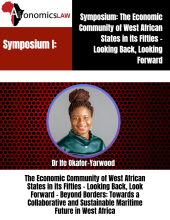
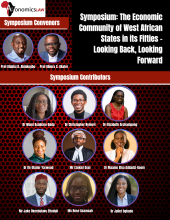
Symposium I: The Economic Community of West African States in its Fifties – Looking Back, Look Forward - Beyond Borders: Towards a Collaborative and Sustainable Maritime Future in West Africa

The ocean and its resources support many sectors vital to the West African region, including fisheries and aquaculture, maritime transport and shipping, maritime security, coastal and maritime tourism, sustainable energy, mineral resources, and emerging marine industries. Collectively, these sectors are called the “Blue Economy” (BE). The BE is a cornerstone of economic growth, sustainability, and security for the twelve coastal and island states and three land-linked countries in the region, providing livelihoods for millions and serving as a primary revenue source for coastal and island states. The BE contributes 56% of the GDP of coastal states in West Africa, underscoring its economic significance. With one-third of the region’s population residing in coastal areas, its ocean and resources are essential to food security, trade, and long-term resilience, making them a crucial driver of sustainable development in West Africa.

Symposium Introduction: The Economic Community of West African States (ECOWAS) in its Fifties – Looking Back, Looking Forward

The Economic Community of West African States (ECOWAS), perhaps the most successful regional economic community in Africa, at least until recently, turns fifty-one (51) on May 28, 2026. ECOWAS, which was established on 28 May 1975 was tasked with the goal of promoting economic and political integration among its member states. Specifically, ECOWAS Treaty offers a key summary of its vision: “promoting co-operation and integration, leading to the establishment of an Economic Union in West Africa in order to raise the living standards of the peoples, and to maintain and enhance economic stability, foster relations-among Member States and contribute to the progress and development of the African Continent.”

Symposium Introduction: The Right to Development and Migration

The symposium brings together four contributions by four distinguished authors. The contributions articulate both the potential and pitfalls of the aspirations/capabilities model of the nexus and highlight particularities when the framing is applied together with other layers (gender, climate crisis, refugees). Two of the contributions discuss their topic using the term “migration” while others look into the issue in the context of “refugees.” Notwithstanding the importance of the distinction between “migrants” and “refugees” in current global frameworks, the purpose here is to stimulate debate that goes beyond this fluid dichotomy. In popular parlance, the term “refugees” is used to connote “migrants” or “non-citizens” in general.

Symposium Call for Papers (Deadline Extended): You’re Not Alone: Normative Debates on (Digital) Solidarity in International Law and Policy

This Call for Papers, hosted by the Afronomicslaw.org and convened by PhD students (Karin Frodé, Christopher Yaw Nyinevi, and Yohannes Eneyew Ayalew) and affiliates of the Castan Centre for Human Rights Law at Monash University, Australia, seeks to examine the broader challenges, opportunities, and debates of digital solidarity in international law and policy. We welcome contributions from both established and emerging scholars with an interest in the topic. We highly encourage submissions from Global South scholars and critical voices addressing these topics in ways that raise matters of concern to Global South communities.