
Gender Mainstreaming

Symposium V: The Economic Community of West African States in its Fifties – Looking Back, Look Forward - Unfinished Business of Gender Equality in ECOWAS
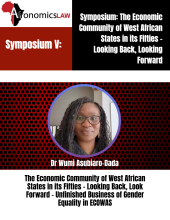
In an ever-growing quest for gender equality, it is quite common for scholars and researchers to overlook regional and sub-regional systems while prioritizing global institutions, particularly the United Nations, its specialized agencies, and other international human rights mechanisms. The limited attention given to regional bodies stems from their perceived lack of influence in implementing meaningful reforms compared to global institutions. Unbeknownst to many, regional systems, despite their marginalization, have developed contextually relevant, progressive policy documents and delivered consequential legal judgments on women's rights. However, as is the case with many international, regional or sub-regional organizations, the perennial challenges remain the translation of the policies and enforcing the far-reaching judgements on women’s rights. The Economic Community of West African States (ECOWAS) embodies this paradox.

Award Without Damages Rendered Against Egypt in Cementos la Union

It was reported that before the operating plant was due to operate in 2008, Egypt implemented new measures requiring the Arabian Cement Company to pay additional licensing and electricity fees. The essence of the case concerned the Egyptian authorities failure to provide gas and electricity supply to the cement plant, as well as the denial of justice by the Egyptian judiciary. Claimants consequently requested USD 236 Million in damages.

The Nigerian Institute of Chartered Arbitrators Annual Conference Report: Making Arbitration and ADR Work for Africa

The focus of the Conference was to promote Alternative Dispute Resolution (ADR) as a viable mechanism for dispute resolution in Africa and to discuss ways to ensure that disputes originating from, and terminating in Africa, are resolved within the continent. This will in turn boost the African economy and promote arbitration law and practice in the region.

Gender Mainstreaming and Empowerment under Agreement for the Establishment of the African Continental Free Trade Area (AfCFTA)

Gender empowerment and trade liberalisation are mutually exclusive, and to think they form an antipodal nexus defeats the purpose of regional trade as envisaged under WTO altogether. I hope that subsequent discussions around AfCFTA will seek to promote and stimulate gender mainstreaming in the carrying out of trade facilitation amongst African countries. Indeed, infrastructural deficit will hinder the realization of AfCFTA. To obtain the benefits under AfCFTA, African countries must aggressively develop their infrastructural capabilities. Most goods are transported through roads. Good road and rail networks facilitate trade within borders and regional areas.