
Women's Rights

Symposium V: The Economic Community of West African States in its Fifties – Looking Back, Look Forward - Unfinished Business of Gender Equality in ECOWAS
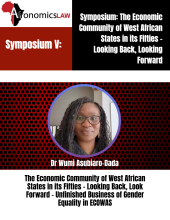
In an ever-growing quest for gender equality, it is quite common for scholars and researchers to overlook regional and sub-regional systems while prioritizing global institutions, particularly the United Nations, its specialized agencies, and other international human rights mechanisms. The limited attention given to regional bodies stems from their perceived lack of influence in implementing meaningful reforms compared to global institutions. Unbeknownst to many, regional systems, despite their marginalization, have developed contextually relevant, progressive policy documents and delivered consequential legal judgments on women's rights. However, as is the case with many international, regional or sub-regional organizations, the perennial challenges remain the translation of the policies and enforcing the far-reaching judgements on women’s rights. The Economic Community of West African States (ECOWAS) embodies this paradox.

Boosting Trade in Africa: Inclusion of Marginalized Trade Actors in Development Financing

In this essay, I argue that while the Zero Draft and Elements Paper recognize the role of trade as a driver of economic growth and development, particularly through regional integration and increased trade finance, these documents fall short of addressing the structural barriers that prevent marginalized trade actors—such as informal cross-border traders (ICBTs), women, and SMEs—from fully participating in and benefiting from trade-driven development. To ensure that trade genuinely fosters inclusive development, the financing for development agenda must move beyond broad commitments and explicitly integrate policies that support marginalized trade actors, particularly within frameworks like the African Continental Free Trade Area (AfCFTA). The following sections critically assess the strengths and gaps in the Zero Draft and Elements Paper and propose targeted policy interventions to enhance inclusivity in trade finance and development.

The African Union and Women’s Rights since its Inception

The Constitutive Act of the African Union (AU) was adopted on 11 July 2000 and came into force on 26 May 2001. The document has been described as 'the turning of a page in the history of the African continent' as it represented the beginning of a new era for the 'political, judicial, and economic organisation for Africa.' The Constitutive Act recognises gender equality as one of its principles.