Symposium on IFFs: Investigating the Impact of Illicit Financial Flows on Unsustainable Debt Burdens in Africa and the Quest for Tax and Debt Justice

Africa is unquestionably confronted with substantial development financing needs, which are further exacerbated by two independent, yet interrelated problems that are depleting the already scarce resources: illicit financial flows (IFFs) and a growing burden of unsustainable debt. To effectively tackle the complex challenges of Africa’s development; including achieving the SDGs, combating the effects of climate change, and resolving human rights issues; it is imperative to address IFF by promoting tax justice and to confront unsustainable debt through debt justice. Given the importance of establishing this link, this blog post delves into the challenges and nexus between IFF and unsustainable debt and provides high level policy recommendations.
Symposium on IFFs: Piercing the Veil of Secrecy in Illicit Financial Flows

In the last decade, there have been seven major leaks of financial documents in tax havens which have exposed the international web of financial flows, mechanisms to facilitate these flows and the major role players in these activities. In each leak, questions often arise on how both legal loopholes and illicit means are used to facilitate the outflow of funds from low- and middle-income countries to tax havens by corporations, wealthy individuals, and politically exposed persons (PEPs). These leaks are often the result of whistleblower-led investigations and the release of these financial documents has become a primary resource in understanding how financial corruption works globally. The effects of these leaks have seen heads of government sacked or resigned in some cases while little to no action takes place in other countries. However, what is undeniable is the role of whistleblowers is increasingly becoming central to curbing illicit financial flows (IFFs) especially as the global digital economy and stronger privacy-enhancing technologies make the detection of IFFs harder. Within Africa, very few countries have comprehensive national laws for whistleblowers despite the majority ratifying international agreements for the protection of whistleblowers. Using Nigeria, Kenya, and South Africa as case studies, this note reviews the regulatory landscape in the countries and the extent to which current laws and practices aid or hinder whistleblowing on IFFs.

Symposium on IFF: Illicit Financial Flows: An Impediment to Africa’s Sustainable Development Introduction

There is no gainsaying the fact that Illicit Financial Flows (IFFs) constitute a major impediment to Africa’s sustainable development. In fact, IFFs have a direct impact on a country’s ability to raise, retain and mobilise its own resources to finance sustainable development. Its negative impact further includes draining a country’s foreign exchange reserves, reducing domestic resource mobilization, preventing the flow of benefits of foreign direct investment, and worsening insecurity, poverty and economic inequality.

One Hundred and Fourteenth Sovereign Debt News Update: Zambia Reaches Agreement with Bondholders to Restructure 3 billion Eurobonds

The African Sovereign Debt Justice Network, (AfSDJN), is a coalition of citizens, scholars, civil society actors and church groups committed to exposing the adverse impact of unsustainable levels of African sovereign debt on the lives of ordinary citizens. Convened by Afronomicslaw.org with the support of Open Society for Southern Africa, (OSISA), the AfSDJN's activities are tailored around addressing the threats that sovereign debt poses for economic development, social cohesion and human rights in Africa. It advocates for debt cancellation, rescheduling and restructuring as well as increasing the accountability and responsibility of lenders and African governments about how sovereign debt is procured, spent and repaid.

Introduction to Symposium on Illicit Financial Flows and Sustainable Development in Africa

Contributors to the symposium offer unique perspectives and draw on different theoretical and methodological approaches to the practice and scholarship related to IFFs in African states and beyond. Several themes were addressed by the contributors, including tax justice, technology, corruption, accountability, political will, repatriation, recovery of Assets, migration, whistleblowing, international investment, and real estate.

News: 4.5.2024

The News and Events category publishes the latest News and Events relating to International Economic Law relating to Africa and the Global South. Every week, Afronomicslaw.org receive the News and Events in their e-mail accounts. The News and Events published every week include conferences, major developments in the field of International Economic Law in Africa at the national, sub-regional and regional levels as well as relevant case law. News and Events with a Global South focus are also often included.

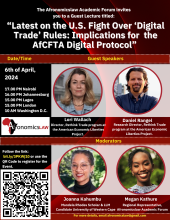
Afronomicslaw Academic Forum Guest Lecture Series: Latest on the U.S. Fight Over 'Digital Trade': Implications for the AfCFTA Digital Protocol

April 2, 2025


Please join us for this virtual conversation on April 6, 2024.

Registration link here.

Guest Speakers:

Lori Wallach, Director, Rethink Trade Program at the American Economic Liberties Project

Daniel Rangel, Research Director, Rethink Trade Program at the American Economic Liberties Project

A Critical Review of the Book “Witness Protection and Criminal Justice in Africa: Nigeria in International Perspective” Focus: Chapters 1 and 7

This review focuses on Chapters 1 and 7 of the book ‘Witness Protection and Criminal Justice in Africa: Nigeria in International Perspective’ by Suzzie Onyeka Oyakhire. The review reflects on specific aspects adopted in discussing witness protection and the complexities surrounding its practice in the Nigerian context as presented by the author.

A Review of the Book-Witness Protection and Criminal Justice in Africa: Nigeria in International Perspective

Witness Protection and Criminal Justice in Africa: Nigeria in International Perspective’, by Dr Suzzie Onyeka Oyakhire, provides an important contribution to the processes aiming to establish witness protection concepts, legislation, and requisite structures for the Nigerian criminal justice system. As Oyakhire points out the challenges in institutionalising witness protection in Nigeria are abundant. For this reason, solid academic research such as her book, will be essential in assisting law makers in drafting a law that on one hand appropriately regulates how witness protection is applied at different stages of proceedings within the specific Nigerian legal, socio-economical, and cultural context and consciously considers what benefit international and national practices and standards could provide to the process on the other. Oyakhire’s caution against applying a ‘one size fits all approach’ and recommendation to be aware of the risk of importing ideas from abroad without due consideration to the national context is highly relevant. This is essential in trying to ensure that whatever system Nigerian authorities decide to implement, it must first and foremost be appropriately adopted to respond to national needs. Some principles for practical implementation of witness protection measures, such as how to mitigate risks through prevention, deterrence, and avoidance, will be similar regardless of the geographical location but finding the appropriate solution to these practical challenges will need to have a local flavour.