Digital Economy

The Informal Economy and African-Language AI in the AfCFTA Digital Trade Regime

The AfCFTA serves as the map for African trade and economic development, its mandate charging the continent toward an economic utopia. Yet its digital protocol, with a core scope built around diversity and vulnerable populations, excludes 90 percent of Africa's economic engine : the informal sector. This exclusion is further compounded by the language exclusion informal enterprises face, where digital platforms and AI systems meant to power digital trade have yet to incorporate indigenous languages, stifled by a data drought that is decades in the making. This paper argues that the interaction of the Digital Trade Protocol and its Rules of Origin Annex leaves informal cross-border traders without a clear, proportionate route to digital trade benefits, and that unequal African-language AI capacity turns the Protocol's promise of legal inclusion into practical exclusion.

Symposium on IFFs: Third World Approach to Economic Globalisation and Digitalisation of the Economy: Assessing Current Initiatives for Combating Tax and Commercially Related Illicit Financial Flows from Africa

Globalisation and digitalisation of the economy has radicalised tax administration and commerce in Africa. While there is still significant room for growth, there has been a paradigm shift in Africa’s development policy landscape over the past three decades. Economic liberalisation measures aimed at opening up the continent to global market forces and attracting foreign direct investment have significantly replaced state intervention and public ownership in most African countries.1 There is a race amongst governments in the continent to optimise and harness the vast tax potential of both the digital economy and the emerging digital finance market involving trading in cryptocurrencies, Non-Fungible Tokens (“NFTs”), and other digital assets. They aim to embrace the regulatory complexities of both the digital economy and the emerging digital finance market with a view to making their countries fit for the digital age and to building a future-ready economy that works for the advancement of their people. However, the rise of globalisation and digitalisation of the economy, including the economic liberalisation that followed, has (amongst other factors) allowed tax and commercially related Illicit Financial Flows (“IFFs”) to thrive in Africa. IFFs from Africa are said to have assumed crisis proportions in recent times.3 Global Financial Integrity (2010) reportedly estimates IFFs from Africa between 1970 and 2008 alone at more than U$1 trillion, an amount that dwarfs the combined inflows of developmental assistance and foreign direct investments into the continent over the same period.4 Nigeria is also reported to have led other resource-rich African economies with this enormous outflow, put at US$217.7 billion, or 30.5% of the total IFFs from Africa within the relevant period.5 Africa is currently estimated to be losing more than US$50 billion to US$86.63 billion annually in IFFs.6

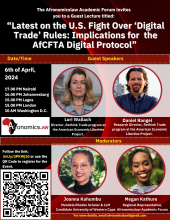
Afronomicslaw Academic Forum Guest Lecture Series: Latest on the U.S. Fight Over 'Digital Trade': Implications for the AfCFTA Digital Protocol

April 2, 2025


Please join us for this virtual conversation on April 6, 2024.

Registration link here.

Guest Speakers:

Lori Wallach, Director, Rethink Trade Program at the American Economic Liberties Project

Daniel Rangel, Research Director, Rethink Trade Program at the American Economic Liberties Project

Towards a United Nations Tax Convention: Prospects and Challenges for Developing Economies

This commentary highlights the prospects and challenges of a UN framework tax convention for developing economies and makes recommendations for mitigating risks. It argues that while the proposed UN framework tax convention may provide a broader forum for increased conversations between developed and developing countries on international cooperation in tax matters, it may not be the magic wand of equal participation in global tax policy formulation hoped for by developing countries. Nevertheless, the adoption of the UN tax resolution is indeed a very significant development in the international tax law and policy space that will form the basis of very engaging conversations in the coming years.

Digital Solidarity in the Sharing Economy

Digital solidarity and the sharing economy may seem like natural companions. To be sure, the sharing economy with its melding of community and commerce has the potential to be a key contributor to digital solidarity in developing economies. Both concepts revolve around the idea of collaboration, sharing resources and funds, community-building, the network effect, increasing trust between strangers, and the leveraging of digital technologies for the greater good. In this blog post, we consider how the sharing economy can contribute to digital solidarity in a developing economy; the barriers to the sharing economy doing so; and if unchecked how it can distort an economy. On that basis, we seek to propose a tentative legal policy for developing economies.

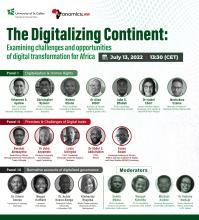
Symposium Introduction: The Digitalizing Continent: Challenges and Opportunities of Digital Transformation for Africa

The fourth Industrial Revolution (4IR) is marked by an intensive digitalisation process. Within the process, digital data (physical information converted into digital) and digital technologies restructure how things are done and values are created. Various initiatives and strategies from the very recent AU Data Policy Framework to the Africa Digital Transformation Strategy (ADTS), the Smart Africa Manifesto and the E-Commerce Protocol of the African Continental Free Trade Area (AfCFTA), which is still under discussion, are intended to galvanize such processes. The regulatory disparity, coupled with the path-dependent asymmetric relationship between actors shapes the degree of leverage they might have over the operation and outcome of such connectivity.

Workshop: The Digitalizing Continent - Examining Challenges and Opportunities of Digital Transformation for Africa

This Workshop, hosted by the Competence Center for African Research (CCAR), University of St.Gallen jointly with the Afronomicslaw.org, seeks to examine the ongoing effort towards digital transformation, and particularly E-Commerce.

NEWS: 6.16.2022

The News and Events published every week include conferences, major developments in the field of International Economic Law in Africa at the national, sub-regional and regional levels as well as relevant case law.