Economic Sanctions

Book Review Symposium I of Economic Sanctions from Havana to Baghdad: Africa as the Most Heavily Sanctioned Region of the World - A Critical Overview

The book Economic Sanctions from Havana to Baghdad: Legitimacy, Accountability, and Humanitarian Consequences raises concerns of social justice, an important ethical issue about the legitimacy of sanctions, and concerns about the humanitarian crises that economic sanctions are bound to cause. Filipenko et al. define economic sanctions as mechanisms that involve restrictive economic measures applied by a country or group of countries to another country or group of countries to coerce the governments of those countries to change their policies. These measures are not only taken by countries against countries but also by international bodies against individuals and entities within countries. These sanctions at the international level are often used to exert political and economic leverage and secure a specific form of capitulation or change from the sanctioned country, entity, or individual.

Book Review Symposium: Introduction to Symposium on Economic Sanctions from Havana to Baghdad: Legitimacy, Accountability, and Humanitarian Consequences

This volume, Economic Sanctions from Havana to Baghdad: Legitimacy, Accountability, and Humanitarian Consequences, published in 2026 by Cambridge University Press, seeks to incorporate many of the perspectives that have been underrepresented in the academic discourse. This includes the work of scholars from sanctioned countries, such as Iran, Iraq, Venezuela, Cuba, and Syria. It also includes the perspectives of practitioners, such as attorneys and humanitarian aid workers. In addition, this volume addresses issues that are complex, but of great significance. For example, while sanctions often include humanitarian exemptions for food, the reality is that the regulatory regimes are so burdensome and unclear that private actors—banks, shipping companies, aid organizations, donors, insurers, and on and on—are driven away from engaging in even legal, humanitarian transactions.

New Book: Economic Sanctions from Havana to Baghdad - Legitimacy, Accountability, and Humanitarian Consequences by Joy Gordon, Ed. (CUP, 2025) (Open Access)

Economic sanctions have been imposed on dozens of countries and thousands of individuals, triggering humanitarian crises and creating economic chaos, often with little accountability. Sanctions can cause particular harm to vulnerable populations, including women, children, migrants, and the poor.

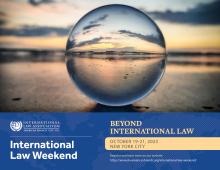
Registration now open: International Law Weekend 2023 - Early-bird discount ends September 10

The American Branch of the International Law Association (ABILA) is excited to announce that registration is now open for International Law Weekend (#ILW2023) which will be held October 19-21, 2023 in NYC. The unifying theme for ILW 2023 is Beyond International Law.

Call for Chapters on Impact of Sanctions in Africa

Prof. Joy Gordon, the Ignacio Ellacuría, S.J. Professor of Social Ethics and the School of Law at Loyola University Chicago is seeking authors working on effects of sanction in Africa. The chapters she is seeking will be published in an edited collection on the humanitarian impact and negative consequences of economic sanctions.  The book will be published by a leading academic publisher.