Foreign Policy

Book Review Symposium I of Economic Sanctions from Havana to Baghdad: Africa as the Most Heavily Sanctioned Region of the World - A Critical Overview

The book Economic Sanctions from Havana to Baghdad: Legitimacy, Accountability, and Humanitarian Consequences raises concerns of social justice, an important ethical issue about the legitimacy of sanctions, and concerns about the humanitarian crises that economic sanctions are bound to cause. Filipenko et al. define economic sanctions as mechanisms that involve restrictive economic measures applied by a country or group of countries to another country or group of countries to coerce the governments of those countries to change their policies. These measures are not only taken by countries against countries but also by international bodies against individuals and entities within countries. These sanctions at the international level are often used to exert political and economic leverage and secure a specific form of capitulation or change from the sanctioned country, entity, or individual.

Book Review Symposium: Introduction to Symposium on Economic Sanctions from Havana to Baghdad: Legitimacy, Accountability, and Humanitarian Consequences

This volume, Economic Sanctions from Havana to Baghdad: Legitimacy, Accountability, and Humanitarian Consequences, published in 2026 by Cambridge University Press, seeks to incorporate many of the perspectives that have been underrepresented in the academic discourse. This includes the work of scholars from sanctioned countries, such as Iran, Iraq, Venezuela, Cuba, and Syria. It also includes the perspectives of practitioners, such as attorneys and humanitarian aid workers. In addition, this volume addresses issues that are complex, but of great significance. For example, while sanctions often include humanitarian exemptions for food, the reality is that the regulatory regimes are so burdensome and unclear that private actors—banks, shipping companies, aid organizations, donors, insurers, and on and on—are driven away from engaging in even legal, humanitarian transactions.

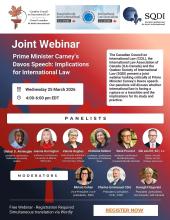
Joint Webinar - Prime Minister Carney’s Davos Speech: Implications for International Law/Le discours de Davos du premier ministre Carney: quelles conséquences pour le droit international?

The News and Events category publishes the latest News and Events relating to International Economic Law relating to Africa and the Global South. Every week, Afronomicslaw.org receive the News and Events in their e-mail accounts. The News and Events published every week include conferences, major developments in the field of International Economic Law in Africa at the national, sub-regional and regional levels as well as relevant case law. News and Events with a Global South focus are also often included.

Online Event: Foreign Economic Policy and the African State: African Agency in the 21st Century

Frederick S. Pardee School of Global Studies, Boston University; African Studies Center; and Global Development Policy Center present an online Event themed: "Foreign Economic Policy & the African State: African Agency in the 21st Century" 

The Coordination of the Foreign Policies of the Member States of CARICOM: A Contemporary Reappraisal

October 7, 2021

The Diplomatic Academy of the Caribbean of the University of the West Indies presents an online Webinar themed "The Coordination of the Foreign Policies of the Member States of CARICOM: A Contemporary Reappraisal". 

It is tailored for those interested in acquiring substantive knowledge and real-world insight on the coordination of the foreign policies of the Member States of the Caribbean Community (CARICOM)

Corruption and South Africa's Foreign Policy

The purpose of my essay is to flesh out why the issue of corruption should be the preeminent foreign policy issue for the South African government – in line with the imperatives of the Constitution and furthered by the jurisprudence of the Constitutional Court and other courts, as well as giving effect to its own commitment of human rights in its most recent Foreign Policy White Paper (mentioned earlier). Moreover, South Africa has ratified the United Nations Convention Against Corruption, adopted in 2003 and coming into force in 2005.

What Role Does the Constitution Play in Shaping and Implementing South Africa's Foreign Policy?

We have argued that the Constitution primarily allocates foreign policy responsibility to the national executive. The President and the Department of International Relations and Cooperation (DIRCO) and its foreign missions are the key actors in the executive responsible for making and overseeing foreign policy. The Constitution prescribes both substantive and procedural rules to guide the executive in its foreign policy choices

When It Comes to the Courts, There's Nothing Really Foreign About "Foreign Policy"

In South Africa’s constitutional scheme, all public power, including foreign policy powers, is subject to judicial review for legality, rationality and compliance with the Bill of Rights. However, the scope of the judicial review – and in particular the standard of rationality – is informed by a certain deference to the executive, in order to respect the democratic principle and its institutional competence. The level of deference will depend on the facts and circumstances of each case. This means that the level of scrutiny to be afforded the other branches of government’s respective foreign relations powers and responsibilities cannot be predicted with any degree of confidence. Rather, the particular circumstances and context of the case will be the primary concern of the courts.

The Role of the Constitution and Courts in the Making and Implementation of Foreign Policy

The courts, utilising their Constitution given powers, have in certain cases declared foreign policy unconstitutional for being inconsistent with the Constitution. The courts have also interpreted foreign policy in order to bring it in line with the Constitution. In so doing, it can be argued that courts have invariably played a role in the making and implementation of South Africa’s foreign policy.