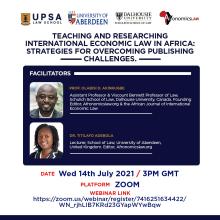
International economic law is an emerging area of teaching, research, and practice in Africa. The area, which is a sub-field of international law, is concerned with the regulation of economic relations between states as well as the conduct of private parties involved in cross-border economic and business transactions.
This blog post highlights the International Law encounter at WBNUJS for the undergraduate programme in addition to the incidental confrontations with International Law for students and my reflections of the same.
If we are to take decolonization of international legal studies seriously, the production of literature, the history of International Law and especially methods of analysis must be destabilized
This symposium presents two interesting memoirs of African students who have participated in these moots and have chosen paths of graduate studies that are related to international economic law and development studies. Mr Mishael Wambua a student at Strathmore University Law and last year winner and best oralist at the John H. Jackson writes about his experience and advice to future mooters. Ms Purity Maritim a former participant of the same moot and now a masters student at the Graduate Institute in Geneva also writes about her experiences and what she learnt from the moot. The other two contributions are from Mr Christian Campbell the Assistant Director FDI moot and Tsotang Tsietsi lecturer and moot coach from the National University of Lesotho. These two contributions present two interesting perspectives on the many directions that moot court competitions can take for Africa in the near future.
To finalise our International Women’s Day symposium on scholarship by women, this post highlights some women working on International Economic Law (IEL) that the editorial team put together in the last couple of days. This post is therefore by no means intended to be exhaustive. We encourage our readers to add to our list. Next year with more time, we hope to have an even more extensive list of women working in IEL.
The combination of the Model Law backbone (both for extant and putative law) and the change in direction of judicial policy in favour of enforcement of arbitration agreements and arbitral awards makes Nigeria well suited for the receipt of FDI in Renewal Energy Projects.
Courts in Africa must construe arbitrability through a narrow interpretation of public policy, loyalty to the doctrine of Kompetenz-Kompetenz, and severability in international commercial arbitration. A proactive judicial approach should be based on distinctive arbitration practices that reflect Africa’s socio-economic background as well as contemporary arbitral trends around the world, as this is a viable means to reduce the influence of public policy on questions of arbitrability in Africa.