Financial Regulation

Book Review Symposium VIII: Corporate Governance in Africa, (Routledge 2025) - Beyond Formalism: A Contextualised Theoretical Framework for Corporate Governance in African Banks

Corporate Governance in Africa, authored by Victor Ediagbonya, Senior Lecturer in Law at the University of Brighton, addresses a pressing but underexplored problem in African banking. The book examines the failure of corporate governance frameworks to protect the interests of stakeholders such as employees and customers when banks collapse. It argues that Nigeria and South Africa have adopted the Anglo-Saxon corporate governance model from the United Kingdom, a model designed around shareholder primacy and premised on the existence of strong legal institutions and active financial markets.

Book Review Symposium VII: Corporate Governance in Africa, (Routledge 2025) - Rethinking Corporate Governance in African Banking: A Functional Stakeholder Approach in Context-Constrained Environments

Victor Ediagbonya’s Corporate Governance in Africa advances a compelling, context-sensitive critique of the transplantation of the Anglo-Saxon, shareholder-centric corporate governance model into African banking systems, particularly Nigeria and South Africa, and proposes a tailored alternative: the Functional Stakeholder Model (‘FSM’). The book’s thesis is straightforward yet significant: corporate governance “best practice” from developed economies performs unevenly when exported to jurisdictions with different institutional realities; banking sectors in countries marked by institutional voids, weak legal enforcement, insider dominated ownership, underdeveloped capital markets, and systemic corruption, require frameworks that are explicitly designed to recognise and protect a broader set of stakeholders beyond shareholders.

Book Review Symposium VI: Corporate Governance in Africa, (Routledge 2025) - Remodelling Corporate Governance in Africa’s Banking Sector – A Fresh Perspective

The Anglo-Saxon corporate governance model practised by most African countries traditionally seeks to protect only the shareholders as the residual owners of an enterprise. (Ngwu, Osuji and Stephen, 2017). The engagement and protection of the interests of various other stakeholders have become an important corporate governance discourse in academia as well as in practice. Given the complexity of the African business environment, the importance of effective stakeholder management cannot be overemphasised and has been a topical issue in recent times. Dr Victor Ediagbonya’s book “Corporate Governance in Africa” presents a transformative exposition of stakeholder management issues in Africa’s banking sector with key references to Nigeria and South Africa.

Professional Training: Competition Law Compliance Training for Fintech Service Providers in Uganda

The News and Events category publishes the latest News and Events relating to International Economic Law relating to Africa and the Global South. Every week, Afronomicslaw.org receive the News and Events in their e-mail accounts. The News and Events published every week include conferences, major developments in the field of International Economic Law in Africa at the national, sub-regional and regional levels as well as relevant case law. News and Events with a Global South focus are also often included.

South Africa’s Exit from the FATF Grey List: A Victory for Institutional Reform, But Not the End of the Journey

On 24 October 2025, the Financial Action Task Force (FATF) removed South Africa from its grey list of “Jurisdictions under Increased Monitoring,” marking the end of 32 months of enhanced scrutiny. This delisting marks a significant milestone in South Africa's efforts to strengthen its anti-money laundering and counter-terrorism financing (AML/CFT) framework. Still, it also signals the start of a new phase that will require sustained commitment to financial integrity.

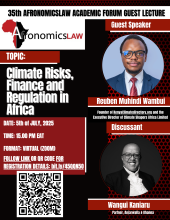
35th Afronomicslaw Academic Forum Guest Lecture - Climate Risks, Finance and Regulation in Africa

This lecture will explore the interlink of climate risks, financial regulation, and sustainable finance, drawing on insights from my advisory work with central banks, financial institutions, and UN agencies, and from my teaching roles at University of Cape Town and Strathmore Business School. The lecture will examine how climate risks affect macroeconomic shocks and explore Africa's evolving climate-related regulatory landscape, including prudential frameworks and disclosure requirements. We will explore recent developments, including new reporting standards, innovative finance products, carbon market regulations, and green finance taxonomies.

FRI Special Issue on Blockchain Regulation - Call for Paper on Banking/Financial Law

The Financial Regulation International (FRI) is a practitioner-focused news service which features articles and opinion pieces about international and domestic financial regulation and private law disputes relating to the financial services industry.