Climate Policy

Symposium: Assessing the First Years of Implementation of the AFCFTA: Challenges and Opportunities — La prise en compte de l’environnement dans l’Accord portant création de la Zone de libre-échange continentale africaine (ZLECAF)

La mondialisation a créé une interdépendance entre États sur plusieurs plans, notamment sur le plan économique. Cela s’est traduit par la conclusion d’accords économiques visant à faciliter et à multiplier les échanges commerciaux entre États. Toutefois, cette multiplication des échanges commerciaux a aussi révélé de nouveaux défis, qui semblent tout aussi importants que les retombées économiques, tels que la protection des droits de l’homme, la protection de l’environnement, etc. Cette prise en compte de l’environnement apparaît comme un élément indissociable du développement socio-économique et, de ce fait, chaque accord international devrait accorder une place primordiale à la question environnementale. C’est le cas pour certains accords tel que l’Accord économique commercial global (AECG), conclu entre l’Union Européenne et le Canada, qui a davantage mobilisé sur les questions liées à l’impact environnemental du libre-échange que sur ses retombées économique.

Sovereign Debt News Update No. 145 : Debt, Climate, and Development - President Ruto’s Call to Action at the Africa Climate Summit

The African Sovereign Debt Justice Network, (AfSDJN), is a coalition of citizens, scholars, civil society actors and church groups committed to exposing the adverse impact of unsustainable levels of African sovereign debt on the lives of ordinary citizens. Convened by Afronomicslaw.org with the support of Open Society for Southern Africa, (OSISA), the AfSDJN's activities are tailored around addressing the threats that sovereign debt poses for economic development, social cohesion and human rights in Africa. It advocates for debt cancellation, rescheduling and restructuring as well as increasing the accountability and responsibility of lenders and African governments about how sovereign debt is procured, spent and repaid. Focusing in particular on Kenya, Zambia, Zimbabwe, Mozambique, Nigeria and Senegal, the AfSDJN will also amplify African voices and decolonize narratives on African sovereign debt . Its activities include producing research outputs to enhance the network’s advocacy interventions. It also seeks to create awareness on and elevate the priority given to sovereign debt and other economic justice issues on the African continent and beyond throughout 2021.

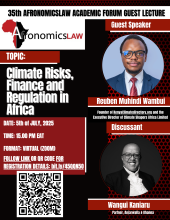
35th Afronomicslaw Academic Forum Guest Lecture - Climate Risks, Finance and Regulation in Africa

This lecture will explore the interlink of climate risks, financial regulation, and sustainable finance, drawing on insights from my advisory work with central banks, financial institutions, and UN agencies, and from my teaching roles at University of Cape Town and Strathmore Business School. The lecture will examine how climate risks affect macroeconomic shocks and explore Africa's evolving climate-related regulatory landscape, including prudential frameworks and disclosure requirements. We will explore recent developments, including new reporting standards, innovative finance products, carbon market regulations, and green finance taxonomies.