Debt Governance

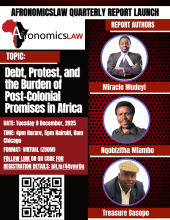
Afronomicslaw Quarterly Report Launch: Debt, Protest, and the Burden of Post-Colonial Promises in Africa

This quarterly report argues that Africa’s ongoing debt crisis is deeply intertwined with the legacies of colonialism, the political pressures of post-independence governance, and the global financial system’s exploitative practices. Recently liberated African states in the 1970s and 1980s faced the dual challenge of fulfilling liberation promises, such as expanding education, healthcare, and infrastructure, while relying on favorable commodity prices to sustain economic growth. This combination of political urgency and economic optimism led to extensive borrowing, often underpinned by forced loans and unrealistic economic forecasting.

Sovereign Debt News Update No. 153: The Afreximbank-Zambia Debt Dispute: A Precedent-Setting Standoff

Following its 2020 default on its US$42.5 million Eurobond payment, Zambia became the first African country to experience a sovereign default during the COVID-19 pandemic. Since then, it has been engaged in a protracted effort to restructure its debt, notably under the G20 Common Framework. This Update explores the divergent positions in this dispute and situates the debate within the broader context of the evolving role of regional multilateral development banks in sovereign debt restructuring. It will also examine Zambia’s strategy of third-party subrogation of Afreximbank’s debt and assess whether it offers a viable path forward in resolving its debt crisis and furthering the relevance of African Multilateral Development Banks in the long-term.

Sovereign Debt News Update No. 140: Senegal’s Debt Misreporting and Debt Transparency Concerns

The African Sovereign Debt Justice Network, (AfSDJN), is a coalition of citizens, scholars, civil society actors and church groups committed to exposing the adverse impact of unsustainable levels of African sovereign debt on the lives of ordinary citizens. Convened by Afronomicslaw.org with the support of Open Society for Southern Africa, (OSISA), the AfSDJN's activities are tailored around addressing the threats that sovereign debt poses for economic development, social cohesion and human rights in Africa. It advocates for debt cancellation, rescheduling and restructuring as well as increasing the accountability and responsibility of lenders and African governments about how sovereign debt is procured, spent and repaid. Focusing in particular on Kenya, Zambia, Zimbabwe, Mozambique, Nigeria and Senegal, the AfSDJN will also amplify African voices and decolonize narratives on African sovereign debt . Its activities include producing research outputs to enhance the network’s advocacy interventions. It also seeks to create awareness on and elevate the priority given to sovereign debt and other economic justice issues on the African continent and beyond throughout 2021.