
Global Economy

En Route to Yaounde: The WTO's Moment of Truth - Ministers Gather in Cameroon as the Multilateral Trading System Faces its Defining Test

As 166 trade ministers converge on Yaounde for the World Trade Organization's Fourteenth Ministerial Conference (MC14), they confront a defining choice: deliver substantive reform or preside over the multilateral trading system's gradual irrelevance. Africa's decision to host this conference at such a critical juncture carries profound symbolic and substantive weight—particularly for the continent's 1.4 billion people and the world's poorest economies whose prosperity depends on rules-based, rather than power-based, international trade.
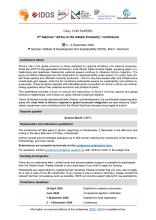
Call for Papers: 3rd Biennial “Africa in the Global Economy” Conference

The News and Events category publishes the latest News and Events relating to International Economic Law relating to Africa and the Global South. Every week, Afronomicslaw.org receive the News and Events in their e-mail accounts. The News and Events published every week include conferences, major developments in the field of International Economic Law in Africa at the national, sub-regional and regional levels as well as relevant case law. News and Events with a Global South focus are also often included.

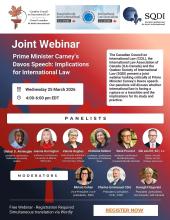
Joint Webinar - Prime Minister Carney’s Davos Speech: Implications for International Law/Le discours de Davos du premier ministre Carney: quelles conséquences pour le droit international?

The News and Events category publishes the latest News and Events relating to International Economic Law relating to Africa and the Global South. Every week, Afronomicslaw.org receive the News and Events in their e-mail accounts. The News and Events published every week include conferences, major developments in the field of International Economic Law in Africa at the national, sub-regional and regional levels as well as relevant case law. News and Events with a Global South focus are also often included.

Africa and the Digital Yuan: Helping China Break U.S. Hegemony Over the Global Financial Order

One of the lessons of the sovereign debt crisis spurred by the COVID-19 global pandemic is that China now plays an outsize role in the African economy, having displaced Western governments and key international organizations to become Africa’s largest bilateral creditor, source of foreign direct investment, and trading partner. After four years of not-so benign neglect Washington’s attention is again focused on Africa, largely to curb the rising influence of China on the continent. However, the United States may discover that in this 21st century “scramble for Africa” many states have already chosen to align their economic interests with Beijing, with serious implications for Washington’s position at the apex of the global financial order. Nowhere is this more clear than in China’s unveiling of its e-currency, the digital yuan, and the potential it has for helping displace the U.S. dollar as the world’s reserve currency.

The 4Rs of Covid-19: ‘Reflect’; ‘Repair’; ‘Reboot’; and ‘Revolutionise’

The global Covid-19 pandemic is an unprecedented shock hopefully many of us will not be alive to see another as disruptive and pervasive as this one. A health crisis that shut down the entire global economic and trading ecosystem for close to a year; a health crisis that has and continues to reconstitute human beings natural social conditioning; a health crisis that has demonstrated political rhetoric does exactly what it says on the tin ‘listen to my words but don’t see my actions’; and a health crisis that brazenly exposed the insatiable appetite for profit, inequality, and power. Indeed, the global pandemic, 18 months later, is proving that walking and chewing gum is a sticky situation for those who believe in the orthodoxy. This blog is a follow-up to a piece I wrote slightly over a year ago that focussed on the Kenya, and with the benefit of hindsight these reflections do ring true for several corners of the continent. As we begin to consider a world post pandemic, I present my 4Rs of Covid-19 of ‘Reflect’; ‘Repair’; ‘Reboot’; and ‘Revolutionise’ as we aim to build forward together.

The Time and Gender of GVCs: 3 Critical Points on the GVC & Development Report 2019

In this short commentary I briefly raise three critical points against the assumptions at the basis of this report. I discuss the temporality of employment in GVCs; the gendered construction of skills and employment disadvantage; and the need to move the debate from individual wages to social wages in order to truly assess the ‘reproductive’ - or more simply, livelihood - implications of GVCs employment on labouring classes.

The Law of Global Value Chains as Transmission Nodes for Global Inequality

The COVID-19 pandemic has exposed the weaknesses of the current patterns of production and consumption, exemplified by GVCs and the global trade and investment order in which they operate. These fragilities have resulted in the aforementioned social, economic and financial crises but what they represent most of all, is a crisis of responsibility in which powerful actors, state and private, that have been the main beneficiaries of GVCs, have failed to discharge their ethical and normative obligations to those most vulnerable within their production and supply chains. To this end, a new approach is sorely needed to address the vulnerabilities of a global economy built on fragile GVC governance that serves as new nodes of global inequality and precarity.

Legal Constitution of Global Value Chains in the Digital Economy

WTO members should revisit the liberalization commitments with a view to engaging in further impact assessments of present and proposed liberalization commitments. More importantly, international and national trade policy makers should welcome new imaginaries of a global digital economy, including the use of trade policy tools to make domestic digital economies competitive at the global stage. This requires a re-conceptualization of the foundations of international trade law, and national tax, competition, property, privacy and data protection laws.

Symposium Introduction - Global Value Chains, Trade and Development

This online symposium is the outcome of a workshop on ‘GVCs, Trade and Development’ hosted by the Kent Law School and IEL collective in July 2020 and supported by the British Academy (Grant no. MD19\190020). The workshop engaged with the policy research literature produced by the World Trade Organisation and World Bank since 2013, in particular their Global Value Chain Development (GVCD) reports of 2017 and 2019.

Revisiting Africa’s Stalled Decolonization – A Response

The laws of the international trading regimes are crafted, not by Africans, but by economists and policymakers in the Global North, with the interest of the elites of the Global North at the heart of any prescriptions. That is why neoliberalism and the “free market” is sold as the panacea for Africa’s developmental impasse.