
Environmental Law

Symposium: Kenya's Seeds Case: The Enduring African Commons of Plant Genetic Resources

The 2025 landmark judgment by the High Court of Kenya in the case of Samuel Wathome and 14 others v Kenya Plant Health Inspectorate Service and another (Samuel Wathome case) fundamentally reaffirmed a broad conceptualization of the previously diminished farmers’ rights to save, exchange, and sell seeds. There had previously been a discernible trend, since the year 2012, of undermining the farmers’ rights through domestic legislation and the ratification of the 1991 International Union for the Protection of New Varieties of Plants (UPOV) Treaty in 2016. Until the 2025 High Court Judgment, the ratification of UPOV 1991 and consecutive amendments to the Seeds and Plant Varieties Act (SPVA) and its implementation Regulations had resulted in an extremely liberal conceptualization of plant breeder’s rights (PBRs) to an extent that they were patent like. The 2022 amendments to the SPVA and implementing Regulations particularly proceeded to the extent of criminalizing the exchange of ‘unregistered’, ‘uncertified’ and ‘unindexed’ indigenous seeds that have, historically, been part of the African commons.
Symposium Introduction: Seed Sovereignty at Stake: Symposium on the Wathome & 14 Others v Kenya Plant Health Inspectorate Service and Another; Greenpeace Environmental Kenya & 2 Others Case

As debates on seeds and plant varieties continue to evolve in Kenya, this symposium reflects on the case and its significance for the future of seed and plant variety protection in the country. In addition to this introduction, the Symposium comprises three contributions: Tom Kabau’s “Kenya’s Seeds Case: The Enduring African Commons of Plant Genetic Resources,” Wambugu Wanjohi’s “Beyond Breeder Rights: Reclaiming Seed Sovereignty, Food Justice and Cultural Autonomy in Kenya,” and Brian Kibet’s “Whose Seeds, Whose Future? Seed Sovereignty and Farmers’ Rights in Kenya.” Kabau argues that the High Court’s judgment is well-grounded in the realities of agricultural practice in Kenya and affirms the enduring character of plant genetic resources as part of the African commons.

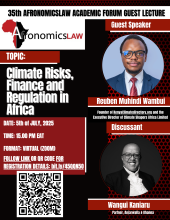
35th Afronomicslaw Academic Forum Guest Lecture - Climate Risks, Finance and Regulation in Africa

This lecture will explore the interlink of climate risks, financial regulation, and sustainable finance, drawing on insights from my advisory work with central banks, financial institutions, and UN agencies, and from my teaching roles at University of Cape Town and Strathmore Business School. The lecture will examine how climate risks affect macroeconomic shocks and explore Africa's evolving climate-related regulatory landscape, including prudential frameworks and disclosure requirements. We will explore recent developments, including new reporting standards, innovative finance products, carbon market regulations, and green finance taxonomies.

Book Review IV: Sustainable Development, International Law, and a Turn to African Legal Cosmologies (Godwin Eli Kwadzo Dzah)

Dzah’s analysis succeeds in meeting the objective stated at the beginning of the book. It does so by diagnosing deficiencies of sustainable development and pointing the reader to a conceptual toolbox from which to draw ethical principles for re-imagining sustainable development. One angle of analysis that could have been addressed in this book is whether there are any drawbacks inherent to African ecocosmologies as a rationality for sustainable development. The analysis leaves the reader with an altogether positive outlook on the legal value of African ecocosmologies.

Book Review III: Sustainable Development, International Law, and a Turn to African Legal Cosmologies (Godwin Eli Kwadzo Dzah) (CUP, 2024)

International law applies to the interchanging relationships and rules between states, including the establishment of norms and standards which govern their activities. This changing landscape of international law is recognised in one of the introductory paragraphs of this book: ‘international law possess an inherent transformative power to renew and remake itself if we are committed to reimagining the discipline and its fundamental characteristics, including the concept of sustainable development’ (pg 2). Sustainable development (SD) has been an integral part of international law discourse before the 1972 United Nations Conference on the Human Environment (UNCHE) and the United Nations Conference on Environment and Development (UNCED). Hence, this book focuses on the ahistoricism and influence of international law on the environment and sustainable development in African legal systems through a Third World Approaches to International Law (TWAIL) lens.

Book Review II: Reimagining sustainable development by centring African customary law: A TWAIL analysis

This book is about reimagining sustainable development. At a time when many scholars have become disillusioned with the concept and calls for abandoning sustainable development in favour of new concepts abound, Dzah makes an impassioned call for us to retain the idea, whose ancient roots predate its co-optation by Western (legal) hegemony, while think about it in a radically different way. The way in which he suggests we do this, is by turning to African relational ontologies and environmental ethics that (re)conceptualise humans “as mere co-occupants of nature with other species”.

Book Review I: Towards Worldview Interactions: A Review of Godwin Eli Kwadzo Dzah, Sustainable Development, International Law and African Legal Cosmologies (Cambridge: Cambridge University Press, 2024)

Dr. Godwin Dzah’s thought-provoking book investigates the actual and potential contributions of Africa and its peoples, including through their rich worldviews, to the making and doing of international law, treating sustainable development as a microcosm. At its core is a vision to deploy Africa’s Indigenous worldviews to reimagine sustainable development, advance thinking on how it should be applied in international law going forward.

Book Review Symposium Introduction: Sustainable Development, International Law, and a Turn to African Legal Cosmologies, Godwin Dzah (CUP, 2024)

I am very happy to introduce the symposium on my book, Sustainable Development, International Law, and a Turn to African Legal Cosmologies, by Cambridge University Press in May 2024. This symposium features four very thoughtful and critical reviews. These four reflections should be read as companion pieces together with my introduction. They address different aspects of the book, provide points of convergence and divergence, and foreshadow future research. I am grateful to these reviewers for their kind engagement with my book, for their constructive criticisms and positive feedback. I am equally grateful to the editors of AfronomicsLaw.org for curating this symposium.

Consultancy Opportunity: Economic Commission for Africa and Africa Trade Policy Centre - Trade and Environment Consultant

The primary objective of this assignment is to contribute to ATPC’s various workstreams centering around the interface of trade policy on the one hand and climate change and environmental concerns on the other within the context of African integration led by trade. The addition of a trade-and-environment expert to ATPC’s pool of experts will allow the Centre to expand, deepen and refine its work and provide opportunities for more robust and in-depth analysis of initiatives taken in this area.