
Illicit Financial Flows

Sovereign Debt News Update No. 161: Discrepancies in Cameroon’s Gold Trade Trigger a National Response to Illicit Financial Flows

Recent disclosures under the Extractive Industries Transparency Initiative (EITI) have been critical in exposing these discrepancies by comparing national export data with international trade statistics. These findings have reframed gold smuggling as a systemic governance and fiscal challenge and have prompted renewed policy attention on curbing IFFs, strengthening traceability, and improving revenue capture in Cameroon’s gold sector. This update examines how EITI-exposed discrepancies in Cameroon’s gold export data have brought illicit financial flows into sharp focus, triggered government enforcement measures, and highlighted the role of global trading hubs, particularly the UAE, in facilitating revenue losses from Africa’s extractive sectors.
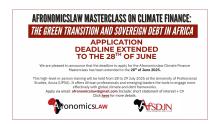

Deadline Extension - Call for Applications: Afronomicslaw Masterclass on Climate Finance, the Green Transition, and Sovereign Debt – Accra, Ghana

Join a Transformative Training at the Intersection of Climate Justice, Economic Sovereignty, and Global Governance. Afronomicslaw invites applications for an in-person Masterclass on climate finance and economic justice training taking place in Accra, Ghana. This high level, interdisciplinary program will bring changemakers from across Africa together to unpack the urgent challenges of climate finance, debt, and economic justice facing the continent.

Introduction to the Written Symposium: The Road to FfD4 – Rethinking Development Financing for Africa’s Future

This symposium aims to provide a platform for African voices to engage with and critique these foundational proposals. Bringing together perspectives from undergraduate and postgraduate students and early career researchers, the symposium reflects the intellectual dynamism of African youth contributing to global financing debates. These contributions underscore the necessity of ensuring Africa’s priorities and perspectives are central to the FfD4 agenda.

Symposium on IFFs: Bridging Tax Treaty Gaps for SDG Success: Unraveling the Impact of Illicit Financial Flows

The escalating concentration of global extreme poverty is particularly pronounced in Africa, where the continent presently accounts for 55% of the total worldwide poverty. Reports indicate that these numbers are expected to rise due to the enduring impacts of climate change, the COVID-19 pandemic, and the conflict in Ukraine. As we hit the six-year mark before the designated milestone for achieving the Sustainable Development Goals (SDGs), it is apparent that African nations are still notably behind in making substantial strides toward the specific targets outlined in the SDG Agenda. Expanding upon the United Nations Millennium Development Goals (MDGs), which concluded in 2015, the SDGs underscore the commitment to addressing a broad spectrum of global challenges. The SDG Agenda tackles 17 pivotal development challenges, spanning areas such as poverty, health, gender equality, crucial aspects of economic growth, urgent global warming issues, social justice, and the promotion of peaceful and inclusive societies. Globally, there is a recognition that countries bear the primary responsibility for addressing systemic issues leading to revenue loss, and global cooperation is essential to supporting national efforts in achieving the SDGs. Within the African context, there have been calls to African leaders to address structural barriers impeding domestic resource mobilization as a key to the successful implementation of development projects aimed at enhancing the lives of African citizens. This is viewed as a sustainable solution to confront the severe and multidimensional nature of poverty in African nations, requiring concerted efforts from leaders to reshape policies that currently facilitate capital outflows.

Global South Dialogue on Economic Crime Inaugural Conference Report: Financial Crime Regulation: A Global South Perspective

The Global South Dialogue on Economic Crime (GSDEC)’s inaugural conference themed Financial Regulation: A global south perspective which held on the 21st of August 2021 was hosted by Aston University, Birmingham. The conference was focused on critically examining whether the current global financial regulatory framework is best suited to combat financial and economic crime in the Global South effectively.

Global South Dialogue on Economic Crime Inaugural Conference themed "Financial Crime Regulation: Perspectives from the Global South"

August 6, 2021

Global South countries continue to lose an immeasurable, though, significant amount of funds yearly to illicit financial flows (IFFs), notwithstanding improvements in global regulatory structures aimed at curbing financial crime. Consequently, it is critical to examine whether the current global regulatory framework is best suited to effectively combat financial crime in the Global South. 

Sixth Sovereign Debt News Update: Capital Projects and their Implications for Debt

The African Sovereign Debt Justice Network brings to you an update of African sovereign debt news and updates on events and happenings on and about Africa that reveal how sovereign debt issues are engaged by the various stakeholders.

Tax Evasion in Latin America and the Caribbean: An Urgent Call for Attention in the Most Unequal Region in the World

The primary objective of this post is to highlight the importance and gravity of the existing tax evasion in Latin America and the Caribbean today. A study conducted by Santiago Diaz de Sarralde Miguez reports that Latin America and the Caribbean are characterized by a relatively low tax burden, which averages 22.8% of GDP. That is 11.5% less than the OECD (2015). While it is true that there are large differences between countries, as the tax burden varies from 12.4% in Guatemala to 38.6% in Cuba.

Development, Climate and Economic Policy: The Need for Narrative Shift

Development, particularly in developing countries, in the current context requires thinking about how multiple global crises are interlinked, their impact on development prospects, and the narrative framing needed to generate positive and progressive systemic policy change.

Hell Breaks Loose in Mozambique: Is this the beginning of the end of irresponsible Sovereign Borrowing? Or a wakeup call to address Benignity of the International Capital Markets?

In the meantime, since the re-entry of Mozambique into the international debt markets may take time, the poor communities may not have the wherewithal to survive that long.  So, what is the last piece of the puzzle? An IMF arrangement with conditionalities? What conditionalities? My next piece intends to consider this.