Sustainable Development

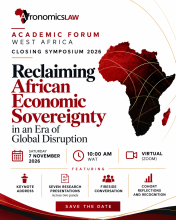
Call for Papers: 3rd Biennial “Africa in the Global Economy” Conference

The News and Events category publishes the latest News and Events relating to International Economic Law relating to Africa and the Global South. Every week, Afronomicslaw.org receive the News and Events in their e-mail accounts. The News and Events published every week include conferences, major developments in the field of International Economic Law in Africa at the national, sub-regional and regional levels as well as relevant case law. News and Events with a Global South focus are also often included.

Book Review V: Taxation, Human Rights and Sustainable Development: Global South Perspectives (Routledge, 2025)

The book Taxation, Human Rights, and Sustainable Development - Global South Perspectives offers a profound interdisciplinary exploration of the intersection between fiscal policy, human rights, and sustainable development. It features a diverse range of contributors arguing that taxation must be understood not merely as a fiscal or economic mechanism for state revenue generation, but as a vital instrument of human rights fulfilment and social justice. The authors contend that tax systems embody the essence of a social contract, mediating the reciprocal obligations between the state and its citizens. At its core, the book asserts that States, bound by international human rights law and domestic constitutional commitments, have an obligation to design and implement fiscal systems capable of respecting, protecting and fulfilling rights. Taxation, therefore, becomes a moral and political process through which states mobilize resources to secure access to healthcare, education, infrastructure, and social protection.

Book Review IV: Taxation, Human Rights and Sustainable Development: Global South Perspectives (Routledge, 2025)

The book is well written, structured, and displays depth of research into the nexus between taxation, socio-economic rights and sustainable development. The book underscores the importance of tax justice in attaining any meaningful and lasting development in the Global South. The book is of immense use not only to students and researchers but also to human rights groups, policy makers and the general public. Apart from the general introduction written as chapter one, the authors divide the book into three major parts with eleven chapters in total. The first part of the book discusses conceptualization and evolution of the role of human rights in taxation while the second part focuses on the role of various stakeholders in taxation. The third part explores the existing relationship between tax compliance and development. However, for ease of reference, I will take the liberty of appraising the book per chapter.

Book Review III: Taxation, Human Rights and Sustainable Development: Global South Perspectives (Routledge, 2025) - A Review

Emerging literature has established that there is a link between taxation and human rights. However, the nature of this link, the existence (or absence) of a coherent normative framework, and how taxation can be leveraged to foster the realization of socioeconomic rights have preoccupied the discussions in the literature. Notably, very few conversations in the literature have exclusively focused the discussion on taxpayers’ perspective in the global south. This is precisely the gap addressed by Taxation, Human Rights, and Sustainable Development: Global South Perspectives, edited by Eghosa O. Ekhator, Newman U. Richards, and Chisa Onyejekwe, and published by Routledge in 2025. As this review will demonstrate, this book makes a significant and timely contribution to the literature for several important reasons.

Book Review I: Taxation, Human Rights and Sustainable Development: Global South Perspectives (Routledge, 2025)

Many discussions of human rights and economic policy feel aspirational, treating rights as guiding principles but stopping short of turning them into concrete legal or administrative action. The edited volume Taxation, Human Rights, and Sustainable Development: Global South Perspectives takes a different path. It digs into the hard work of turning human rights into working law and policy for taxation, viewed through experiences and priorities in the Global South.

Book Review Symposium Introduction: Taxation, Human Rights and Sustainable Development: Global South Perspectives (Routledge, 2025)

Human rights play an integral role in State revenue sourcing and taxation in different parts of the world. For countries in the Global South, it should be an obligation to consider human rights in their tax policies and legislation as they need a sustainable revenue source to meet their socio-economic responsibilities (the welfare state) of which tax revenue is major slant. This goes to the foundations of a good tax system. Drawing lessons from the Global South, this book examines whether human rights can be invoked in the debate on creating effective tax regimes across the various jurisdictions.

Afronomicslaw Sovereign Debt Quarterly Brief No. 10, 2026: Development Finance in Africa and the Institutionalized Risk Premium

This study develops a new framework for understanding the premium by introducing the concept of an “institutionalized” African risk premium. In doing so, the study identifies three distinct forms of the African risk premium: (a) the perceived African risk premium; (b) the real African risk premium; and (c) the institutionalized African risk premium.

Symposium: Assessing the First Years of Implementation of the AFCFTA: Challenges and Opportunities — La prise en compte de l’environnement dans l’Accord portant création de la Zone de libre-échange continentale africaine (ZLECAF)

La mondialisation a créé une interdépendance entre États sur plusieurs plans, notamment sur le plan économique. Cela s’est traduit par la conclusion d’accords économiques visant à faciliter et à multiplier les échanges commerciaux entre États. Toutefois, cette multiplication des échanges commerciaux a aussi révélé de nouveaux défis, qui semblent tout aussi importants que les retombées économiques, tels que la protection des droits de l’homme, la protection de l’environnement, etc. Cette prise en compte de l’environnement apparaît comme un élément indissociable du développement socio-économique et, de ce fait, chaque accord international devrait accorder une place primordiale à la question environnementale. C’est le cas pour certains accords tel que l’Accord économique commercial global (AECG), conclu entre l’Union Européenne et le Canada, qui a davantage mobilisé sur les questions liées à l’impact environnemental du libre-échange que sur ses retombées économique.