Law and Development

Symposium: Assessing the First Years of Implementation of the AFCFTA: Challenges and Opportunities — The Guided Trade Initiative: An Appraisal of AfCFTA National Implementation Vehicles

The African Continental Free Trade Area (AfCFTA) is the world’s largest free trade area in terms of the participating countries since the formation of the World Trade Organization (WTO). The AfCFTA Agreement brings together 55 African Countries who are contracting member states to the 8 existing Regional Economic Communities in Africa, including the newly formed Alliance of Sahel States (former members of ECOWAS). As of September 2024, 54 of the 55 AU member states have signed the AfCFTA Agreement and 47 have ratified the Agreement. The AfCFTA aims to create a single market for trade in goods and services and allow free access to tradeable commodities across the continent. Although the AfCFTA is not fully operational, meaningful commercial trading has been envisioned through the Guided Trade Initiative (GTI). The GTI is a pilot project that tests the operational, institutional, legal and trade policy environment of the AfCFTA.

Symposium: Assessing the First Years of Implementation of the AFCFTA: Challenges and Opportunities — A Critical Analysis of Dispute Resolution under the African Continental Free Trade Area (AfCFTA) Regime

Dispute settlement is a central tenet of any economic block as it provides the necessary security and predictability for the state parties. The Architecture of the AfCFTA is reflective of these principles as the AfCFTA Agreement has introduced a rules-based dispute settlement regime which mirrors the WTO’s Dispute Settlement Understanding. The success of the AfCFTA is highly dependent on the effectiveness of the dispute settlement mechanism. In considering the Dispute Settlement Mechanism (DSM) of the AfCFTA this piece highlights the salient features of the DSM and explores some of the challenges that should be anticipated. This piece fronts the argument that the AfCFTA should have diverged from the traditional dispute settlement mechanisms adopted by the WTO. Further, it attempts to answer the question on whether African States will utilize the DSM given the current status quo of the dismal use of the WTO’s DSM.

Symposium: Assessing the First Years of Implementation of the AFCFTA: Challenges and Opportunities — La prise en compte de l’environnement dans l’Accord portant création de la Zone de libre-échange continentale africaine (ZLECAF)

La mondialisation a créé une interdépendance entre États sur plusieurs plans, notamment sur le plan économique. Cela s’est traduit par la conclusion d’accords économiques visant à faciliter et à multiplier les échanges commerciaux entre États. Toutefois, cette multiplication des échanges commerciaux a aussi révélé de nouveaux défis, qui semblent tout aussi importants que les retombées économiques, tels que la protection des droits de l’homme, la protection de l’environnement, etc. Cette prise en compte de l’environnement apparaît comme un élément indissociable du développement socio-économique et, de ce fait, chaque accord international devrait accorder une place primordiale à la question environnementale. C’est le cas pour certains accords tel que l’Accord économique commercial global (AECG), conclu entre l’Union Européenne et le Canada, qui a davantage mobilisé sur les questions liées à l’impact environnemental du libre-échange que sur ses retombées économique.

Symposium: Assessing the First Years of Implementation of the AFCFTA: Challenges and Opportunities — La coexistence entre la Zone de libre-échange continentale africaine et les Communautés économiques régionales africaines

L'intégration économique régionale entendue comme « un processus qui conduit plusieurs économies distinctes à former un seul espace économique » (Beitone, Cazorla, Dollo, Drai, Dictionnaire de science économique, p. 290) régional représente un enjeu majeur pour le développement des États. Cette intégration économique est organisée en degrés correspondants aux différentes formes d’intégration. L’un de ses premiers degrés d’intégration est appelé la zone de libre-échange (Elsa Tapsoba, Intégration économique et normes internationales du travail en Afrique de l’Ouest (UEMOA) p.18). Celle-ci correspond à la zone dans laquelle est assurée l’abolition des droits de douane et des barrières non tarifaires entre les pays membres d’une communauté avec toutefois une indépendance des politiques tarifaires extérieures. Il existe plusieurs zones de libre-échange à travers le monde telles que L’Accord de Libre Échange Nord-Américain, le MERCOSUR,Partenariat Économique Régional Global (Regional Comprehensive Economic Partnership Agreement en anglais) et la liste n’est pas exhaustive.

Symposium: Assessing the First Years of Implementation of the AFCFTA: Challenges and Opportunities — The Geopolitics of Neo-Colonial Trade and the Necessity of an Effective AfCFTA

The African Continental Free Trade Area (AfCFTA) represents the most ambitious attempt to unify the continent’s markets under a single framework, with the potential not only to expand intra-African trade but also to reposition Africa within the global economy. Can the AfCFTA break Africa’s cycle of dependency and reposition the continent in the global economy? In this paper, we aim to offer an analysis of the impact of persistent colonial institutional practices on development in Africa, and the role of an African Continental Free Trade Area in articulating agency, creating shockproof economies, establishing continental trade corridors, building regional value chains, and finally asserting Africa’s position in the global economy.

Symposium Introduction: Assessing the First Years of Implementation of the AFCFTA: Challenges and Opportunities

The Blog Symposium is therefore a collective intellectual journey across Africa’s diverse regions, from north to south, west to east. It reflects a multiplicity of perspectives, backgrounds, and academic traditions, united by a shared commitment to Africa’s economic integration and transformation. This could have not been possible without the assistance, advise and support of Prof Olabisi Akinkugbe and the whole AfronomicsLaw team. We are grateful for this platform which is making an unprecedented contribution in amplifying African voices in the space of international (economic) law.

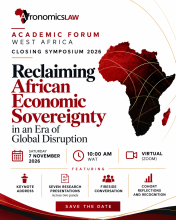
The AfronomicsLaw Academic Forum (West Africa) Hosts its Inaugural Afronomicslaw Lab Session

The News and Events category publishes the latest News and Events relating to International Economic Law relating to Africa and the Global South. Every week, Afronomicslaw.org receive the News and Events in their e-mail accounts. The News and Events published every week include conferences, major developments in the field of International Economic Law in Africa at the national, sub-regional and regional levels as well as relevant case law. News and Events with a Global South focus are also often included.

Book Review III of The African Continental Free Trade Area Agreement: The Development of a Rules-Based Trading Order

While much has been written about the African Continental Free Trade Area (AfCFTA), very few studies address the social, political and cultural implications of this new regional bloc from the perspective of international economic law. In this respect, Professor Kufuor’s book pushes disciplinary boundaries and presents an original account of how markets have been constituted, expanded and reformulated across Africa. Kufuor draws on a range of theoretical lenses from international political economy, jurisprudence, history, sociology and economics to critically evaluate what institutional shifts will be required at different levels of governance if the aim of pan-African unification through a rules-based order is to materialise.

Webinar: Climate, SDGs, Debt and the International Responsibility of the IFIs: Does the ARIO need to be updated?

Join us for a roundtable discussion on the unique status of international financial institutions (IFIs) in international law. This conversation will focus on whether, in international legal terms, international financial institutions (IFIs) should be treated like any other international organization or if their specialized mission necessitates granting them a special status. It will assess the validity of the IFIs concerns that the Articles on Responsibility of International Organisations (ARIO) are not easily applied to their operations and what changes may be needed to address these concerns.